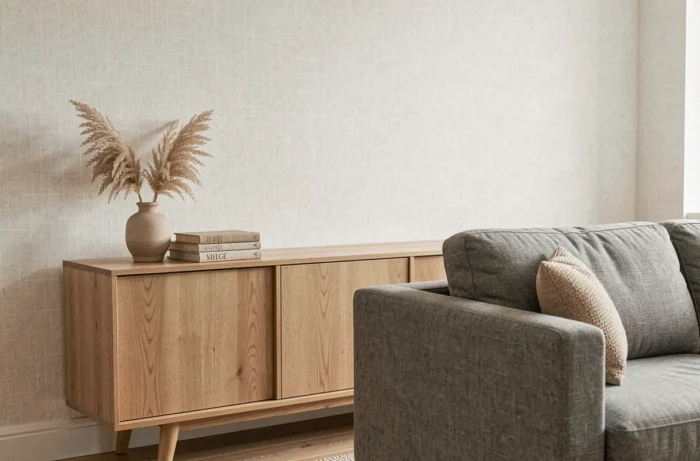
White non-woven wallpaper is about more than personal preference for texture or a smooth surface. Choosing between a linen effect and a smooth finish involves technical considerations related to the condition of the wall, the room’s exposure and how the covering will perform over time. Two finishes, two installation approaches and two distinct visual results on the wall.
Wall condition: the factor a finish cannot fix
Smooth white wallpaper makes every wall imperfection more visible. Hairline cracks, poorly sanded plasterboard joints and slight bumps are all accentuated by light grazing across a flat surface. Manufacturer specifications consistently recommend smooth finishes for well-prepared walls, with carefully applied smoothing compound and fine sanding.
The raised weave of a linen effect changes how minor irregularities are perceived. The texture diffuses light instead of reflecting it in a straight line, visually softening small imperfections. One point is worth stressing: this property is no substitute for properly preparing the wall. Holes or deteriorating plaster will not be concealed by a textile-like texture.
When renovating older walls with uneven plaster, a linen effect offers more leeway than a smooth finish. On new plasterboard partitions with properly finished joints, smooth wallpaper works perfectly well. The choice should therefore be made when assessing the project, before considering the décor.
When the wall has slight undulations, linen-coloured wallpaper with its pronounced texture remains the most reliable option for an even finish.
White wallpaper in kitchens and bathrooms: dry areas versus damp areas
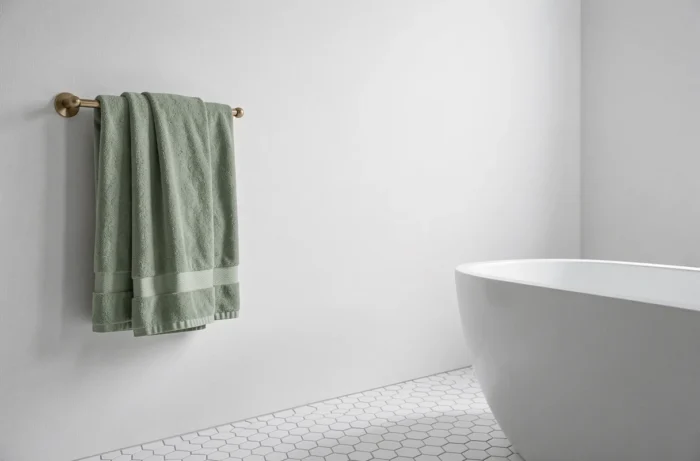
The word “washable” on a roll of white non-woven wallpaper does not mean it can be used in any conditions. Manufacturers clearly distinguish between areas exposed to water or high humidity (showers, kitchen backsplashes behind the sink) and areas that are simply warm or occasionally damp (toilets, the wall opposite the bathtub).
White non-woven wallpaper, textured or smooth, should be limited to dry areas of the room, provided there is adequate ventilation. In a bathroom without an effective mechanical ventilation system, lingering steam will eventually loosen the wallpaper or encourage mould to grow beneath it, whatever the finish.
In the kitchen, a smooth finish has a practical advantage: it is easier to clean than a textured surface. The tiny recesses in a linen effect can trap grease splashes and cooking vapour residue. A wipe with a damp sponge is enough for a smooth finish, whereas a linen effect requires more thorough cleaning.
- Kitchen wall away from the cooking area: both finishes are suitable, with a slight advantage to smooth wallpaper for everyday cleaning
- Well-ventilated bathroom, wall outside the splash zone: a linen effect adds texture without risk, provided you air the room after every shower
- Toilet: both finishes work without restrictions, as ambient humidity remains low
- Backsplash or area exposed to direct splashes: no white non-woven wallpaper is suitable; choose vinyl wallcovering or tiles instead
Light and atmosphere: linen effect in the bedroom, smooth finish in the living room
The texture of white wallpaper directly affects how light behaves in a room. A linen effect absorbs and diffuses natural light, creating a soft, matte atmosphere with a visual depth that smooth, pure white wallpaper cannot achieve.
In a bedroom, this diffusion reduces glare and softens the atmosphere. A smooth white wall opposite a window reflects light more directly, which can feel harsh when you wake up. A linen effect filters this reflected light while preserving the room’s overall brightness.
In a living room or entryway, a smooth finish serves a different purpose. It increases light reflection and makes the space appear larger. In a narrow hallway or a dimly lit room, a smooth finish makes the most of every available light source. In these settings, a linen effect can make the room feel slightly darker.
The choice also depends on the furniture and furnishings. A pared-back Scandinavian interior benefits from a smooth finish, whose flat surface complements clean lines. A more organic décor, with raw wood or textiles, feels more cohesive with the visible weave of a linen effect. The wall texture works in harmony with the materials in the room.
Installation and seams: technical differences between the two finishes
With non-woven wallpaper, paste is applied to the wall, not the wallpaper strip. This is the same for both finishes. The difference lies in the seams between strips.
Smooth white wallpaper requires perfectly aligned edge-to-edge seams. Even the slightest overlap or gap between two strips creates a visible shadow line, especially in side lighting. There is virtually no margin for error when matching seams on smooth white wallpaper.
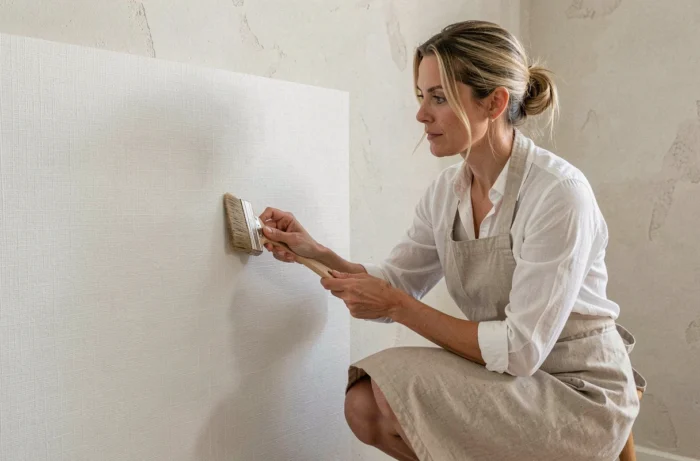
A linen effect is more forgiving. The texture breaks up the visual continuity of the seam: the eye notices the raised pattern before the join. For a DIY installer, this can be a deciding factor. A slightly imperfect seam goes unnoticed on textured non-woven wallpaper, whereas it leaves a permanent mark on a smooth wall.
- DIY installation with no prior experience: a linen effect reduces the risk of visible seams
- Professional installation on a new wall: a smooth finish delivers a taut, flawless result
- Large glazed areas in the room (frequent grazing light): a smooth finish makes installation flaws more noticeable
Whether textured or smooth, white non-woven wallpaper is a wallcovering whose final appearance depends as much on the wall and the installation as on the finish itself. A linen effect suits imperfect walls and restful rooms, while a smooth finish is best for bright spaces and flawless surfaces. Make the right choice wall by wall, not room by room.