
Every year, millions of French households make changes to their interiors, from simply changing a wall color to completely reorganizing a room. Since January 1, 2025, homes rated G on the energy performance certificate (DPE) have no longer been considered fit for rental in mainland France, prompting some landlords to rethink their priorities between decorative upgrades and energy-efficient renovations.
Improving your interior is about more than choosing a pretty cushion: air quality, how spaces are actually used, and the durability of materials all matter just as much as aesthetics.
Emissions from decorative products and indoor air quality
Paints, adhesives, flooring, and new furniture can release volatile organic compounds for several weeks after installation. These substances are invisible and often odorless after the first few days, but they can reduce air quality in freshly decorated rooms.
The French A+ rating for pollutant emissions applies to construction and decorative products, but not to furniture. A new sofa or a bookcase made from particleboard may therefore release pollutants without any indication on the packaging. Thoroughly airing out the space during and after work remains the most effective precaution.
Houseplants are often presented as natural filters, but their main contribution is to a room’s visual appeal. They are no substitute for mechanical ventilation or opening windows. An arrangement that covers or blocks a ventilation outlet (a piece of furniture pushed against a vent, or a curtain hanging in front of a mechanical ventilation system) cancels out the benefits of fresh air, no matter how many ficus plants are in the room.
Several online resources explain these precautions in more detail, including Airnews’s home decor blog, which explores ways to improve your interior from a home expertise perspective.
Test a room layout before you buy
Rearranging a living room or bedroom on paper or in your head rarely gives the same result as trying it out in real life. A modular piece of furniture (sofa bed, extendable table, fold-down desk) takes up a very different amount of space when fully extended. Without measuring first, it could block a walkway, prevent a door from opening fully, or make a drawer inaccessible.
Measure the space as it will be used
Measuring the room alone is not enough. You also need to measure the space when each item is open: drawers pulled out, closet doors swung open, and seats unfolded. An occasional guest bed has different requirements from a bed used every day, both in terms of space and access.
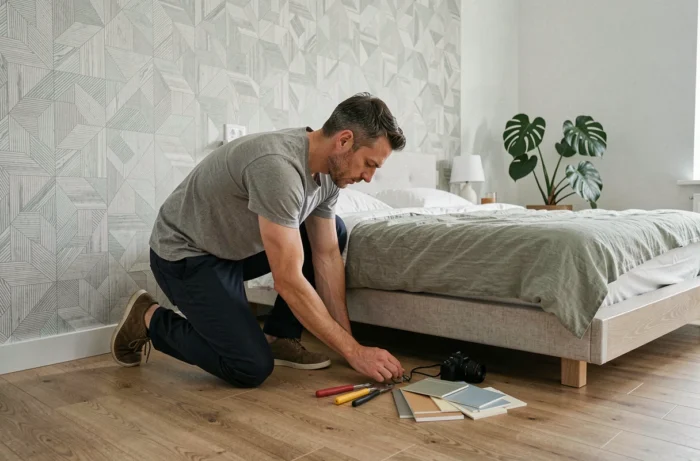
Mocking up the layout with masking tape on the floor (to mark the footprint of a piece of furniture) or with cardboard cut to the right dimensions can help you spot practical conflicts before you buy. This takes about 15 minutes and can save you the cost of returns.
Movement and natural light
A comfortable walkway between two pieces of furniture should be at least as wide as two shoulders. Placing a bookcase in front of a window reduces the amount of natural light throughout the room, which can then lead you to add more artificial lighting and change the atmosphere you were aiming for.
- Make sure at least half of each window remains unobstructed to preserve sufficient natural light
- Keep the area in front of ventilation outlets, radiators, and electrical outlets used every day clear
- Test frequently used routes (kitchen to table, entrance to living room) with the proposed layout in place, carrying a bulky item such as a tray or laundry basket
Reuse and repair: refresh a room without buying new
Improving an interior often starts with the urge to shop: a new piece of furniture, a trendy accessory, or a light fixture spotted online. Before adding anything, take a look at what you already have at home.
Repairing or personalizing an existing piece of furniture can refresh a room’s atmosphere without creating waste or costing much. Sanding and repainting a chest of drawers, changing the handles on a sideboard, or trimming shelves to fit a new wall can transform an item just as much as replacing it.

If you do need to buy something, repairability and lifespan are worth considering. A solid wood piece of furniture with screw-fastened joints can be taken apart, repaired, and resold. A piece made from glued melamine-faced panels has a limited lifespan and often ends up at the recycling center after just one move.
Colors and decor style without replacing everything
Sometimes, changing the color of a wall is enough to alter how an entire space feels. An accent wall in a bold shade can visually reshape a room without changing the furniture. The right color depends on the room’s orientation: warm tones make up for a lack of light on the north side, while cool shades temper a room that faces due south.
Replacing textiles (curtains, cushions, rugs) is another low-cost way to refresh a room. These items can be changed with the seasons or as your tastes evolve, without major work. A common mistake is to accumulate too many decorative items in a small space, creating the opposite of the desired effect: a feeling of clutter rather than comfort.
Landlords: decor comes after energy efficiency
For landlords, energy renovation requirements take priority over decorative makeovers. Homes rated G on the DPE have been affected since January 2025, with ratings F and E to follow under a phased schedule.
Investing in a trendy kitchen or redesigned living room makes less sense if the property does not meet energy-efficiency standards for decent housing. Insulation work, window replacement, and heating upgrades should come first. Decor can follow, taking into account any constraints created by the work (radiators in new positions, extra thickness from internal insulation, or changes to room dimensions).
Improving your interior in 2025 means considering three factors together: aesthetics, practical use, and health. Checking product emissions, testing the layout in real-life conditions, and prioritizing repairs before buying are three simple habits that cost little and help prevent an upgrade from creating a new problem.