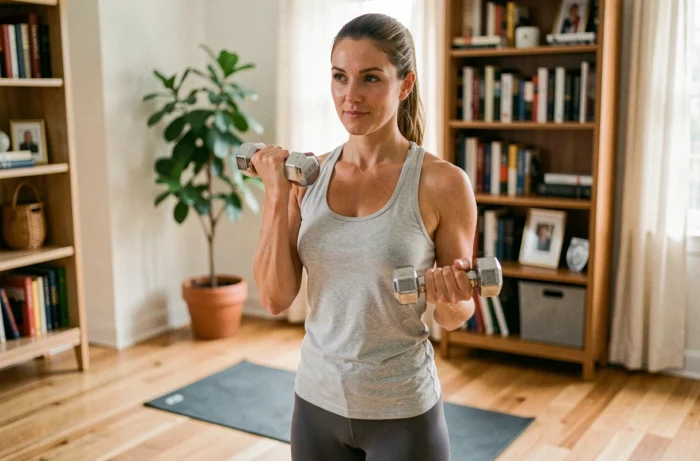
Doing lateral raises with 1 kg dumbbells, the first twenty reps feel effortless, then the burn kicks in around the thirtieth. You put the dumbbells down and wonder whether that sensation is enough to work the muscle. The answer depends less on the number printed on the dumbbell than on how challenging the last few reps feel.
A 2017 meta-analysis by Schoenfeld and colleagues found that low and high loads can produce comparable muscle growth, provided sets are performed with effort close to muscular failure.
How hard are 1 kg weights really? What research says about light loads
Weight alone does not determine the outcome. What matters is how close you get to failure by the end of the set. For a small muscle such as the lateral deltoid or the biceps of someone who is sedentary, 1 kg can provide significant resistance during the first few weeks.
Lasevicius and colleagues (2022) found that light-load training taken to failure stimulated muscle growth more effectively than light sets stopped well before fatigue. In other words, if you put the dumbbell down when you could still do ten more reps, the stimulus is not enough.
In practice, using 1 kg dumbbells works well for beginners doing isolation exercises (lateral raises, wrist curls, external shoulder rotations). For exercises that target large muscle groups (squats, rows, presses), this weight quickly becomes negligible, even for a complete beginner.
One thing to keep in mind: the 2017 meta-analysis also notes that heavier loads remain more effective for improving maximal strength. If your goal is to lift heavier over time, sticking with 1 kg will not get you there.
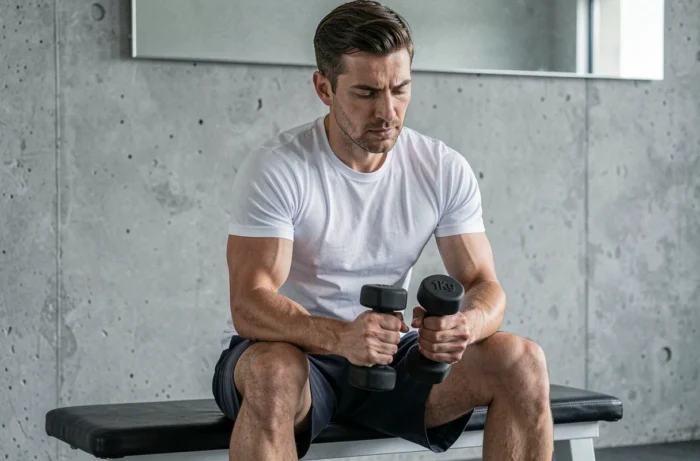
When to increase the weight of your dumbbells: how to recognize the right time
The most reliable indicator is how many reps you can perform with good form. When you regularly exceed 30 reps without the last two or three feeling genuinely difficult, the weight is no longer creating enough mechanical tension.
At this point, you have three options. The right one depends on the exercise and the equipment available.
- Move up to heavier dumbbells (1.5 or 2 kg) and aim for around 12 to 20 reps per set, keeping the movement controlled through the full range of motion.
- Make the exercise more challenging with the same weight: slow the lowering phase to 3–4 seconds, pause in the contracted position, or work one arm at a time to eliminate compensations.
- Replace the exercise with a bodyweight movement that targets the same muscle group with more resistance (push-ups instead of dumbbell presses, chair dips instead of triceps extensions).
Good technique matters more than the urge to lift heavier. If moving up to 2 kg makes you lose control of the movement (your shoulder rises during a curl, or your back arches during a raise), go back to the lighter weight and add a slow tempo.
A practical guide for every workout
Before the set, estimate how many reps you think you can do. Afterward, note how many you completed and whether the last three were tough. When the gap between your estimate and reality grows (you thought you could manage 20 reps, but you do 35 without straining), it is time to change something.
This self-assessment works better than a rigid progression schedule. Your ability to recover varies from one workout to the next depending on sleep, stress, and nutrition, and a weight that felt light on Monday may feel challenging again on Thursday.
1 kg dumbbells and suitable exercises: where they remain useful over time
The problem is not that 1 kg is inherently too light. It is that some exercises outgrow this weight quickly. In compound movements (goblet squats, lunges, rows), the body recruits powerful muscles (quadriceps, lats, glutes) that adapt within a few workouts.
By contrast, 1 kg remains useful for movements that target small muscles or protect vulnerable joints:
- External shoulder rotations for the rotator cuff, used in rehabilitation and injury prevention.
- Wrist extensions for the forearms, where increases in weight are naturally gradual.
- Slow-tempo lateral raises (4 seconds up, 4 seconds down), which make 1 kg a sufficient load even for an intermediate trainee.
The WHO recommends that adults do muscle-strengthening activities involving all major muscle groups at least two days a week, without specifying a weight or number of reps. Working only with 1 kg on isolation exercises does not meet this recommendation if the major muscle groups (legs, back, chest) are never challenged.
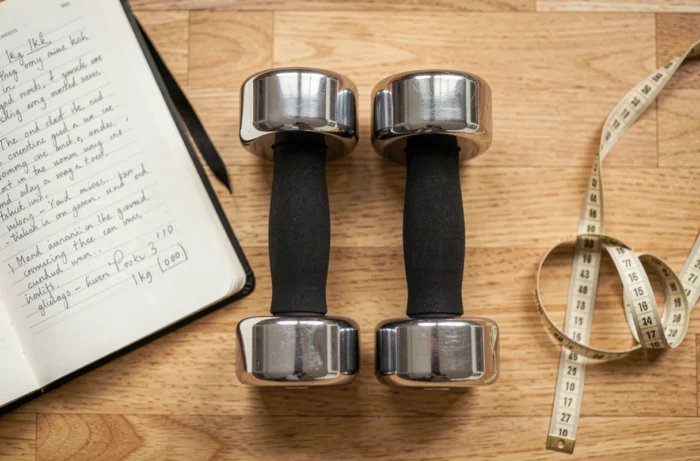
Progressing beyond 1 kg: adjustable dumbbells or bodyweight exercises
When most exercises exceed 30 easy reps, investing in a pair of adjustable dumbbells gives you a wide range of weights without taking up much space. Models with standard 30 mm plates can take widely available weight plates and let you increase the load gradually.
The least expensive alternative is bodyweight training. Push-ups, Bulgarian split squats, and inverted rows target major muscle groups without any extra equipment. Keep the 1 kg dumbbells for isolation and mobility exercises, and use bodyweight movements or heavier weights for more demanding work.
A setup consisting of a pair of 1 kg dumbbells, a pair of 3–5 kg dumbbells, and a few bodyweight exercises covers most beginners’ needs for several months. The goal is not to accumulate equipment but to make every set challenging during the last few reps, whatever weight you use.