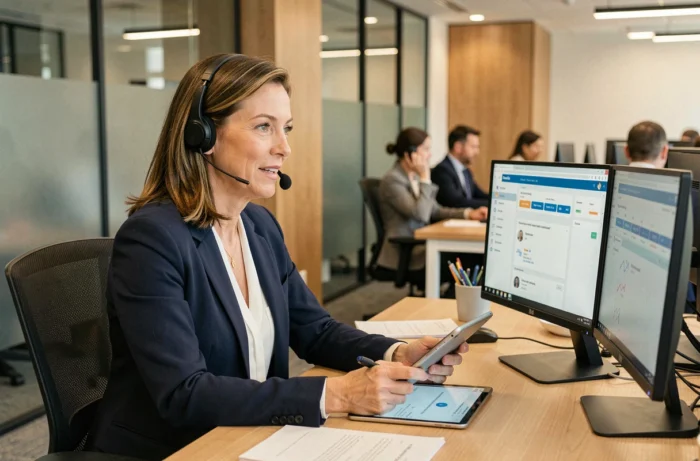
The French market for outsourced customer relations now exceeds 3.5 billion euros and has been growing by about 2% per year since 2021. This steady growth reflects a shift: outsourcing the telephone switchboard is no longer seen as just a cost-cutting lever, but as a structural choice for service quality and operational continuity.
Outsourced switchboard and regulatory framework: what changed in August 2026
Since August 11, 2026, France has prohibited B2C telemarketing without the explicit consent of the consumer. This opt-in requirement, stemming from law no. 2025-594 of June 30, 2025 and decree no. 2026-662 of July 23, 2026, has replaced the Bloctel system with a stricter regime.
The permitted hours for commercial calls are now limited to Monday-Friday, from 10 AM to 1 PM and from 2 PM to 8 PM. For companies managing their switchboard in-house, this constraint requires training teams, updating call scripts, and documenting consent evidence.
A specialized service provider integrates these obligations into its processes from the outset. Filtering incoming and outgoing calls, tracking consent, and adhering to time slots are tasks it handles without mobilizing internal resources. For an SME that deals with both incoming customer calls and sales follow-ups, the decision to subscribe to an outsourced telephone switchboard simplifies compliance with this new legal framework.

Combination of human and artificial intelligence in telephone reception
The question facing companies is no longer whether to choose between human reception and an automated solution. The topic has become: how to combine human and AI for a 24/7 reception capable of handling simple requests while reserving complex calls for qualified operators.
Specifically, an AI-driven voice agent can manage appointment scheduling, transfer calls to the right department, or respond to recurring questions (hours, address, order status). The human operator intervenes in situations that require listening, negotiation, or contextual judgment.
Limits to know before betting on voice AI
Field feedback varies on the actual capacity of voice agents to handle emotionally charged calls or ambiguously phrased requests. An unhappy or confused caller may find themselves in a reformulation loop that degrades their experience.
The outsourced provider that integrates AI into its offering must therefore define clear switching thresholds:
- After how many seconds or unsuccessful attempts the call is transferred to a human
- What types of requests are exclusively handled by an operator (complaints, emergencies, high-value clients)
- How conversations are recorded and processed in compliance with GDPR, particularly the obligation to inform the caller and obtain their consent before any recording
Without these safeguards, automation can produce the opposite effect of what is intended: a degradation of the company’s image perceived from the very first telephone contact.
Real cost of an outsourced switchboard versus internal management
Industry competitors highlight cost reduction as the primary argument. The topic deserves to be examined with more nuance. The visible cost of a provider sometimes masks indirect expenses: initial setup, adaptation of scripts, training on the client’s business specifics, or additional costs in case of unexpected call spikes not covered by the contract.
Internally, the calculation is no simpler. One must add the loaded salary of one or more receptionists, the telephone infrastructure, maintenance, absences to cover, and supervision time. For an organization with fewer than fifty employees, this position can represent a significant portion of the operating budget.
What pricing grids do not always show
Several billing models coexist: monthly flat rate, per call handled, or mixed formula. The flat rate is suitable for companies with stable and predictable call volumes. Billing per call exposes one to overruns during peak activity periods, which can erase the expected savings.
Before comparing quotes, it is useful to measure the actual volume of incoming calls, their average duration, and the proportion of calls requiring transfer or complex handling over a few weeks. This data allows for negotiating a tailored contract rather than accepting a standard grid.
GDPR and call recording: provider obligations
Outsourcing one’s telephone switchboard involves entrusting a third party with personal data of callers. GDPR imposes specific obligations in this regard, and responsibility remains shared between the client company and the provider.
If call recording is practiced, it is necessary to clearly inform the caller at the beginning of the conversation and, in some cases, to obtain their consent. The provider must also ensure the security of storage, define a retention period, and allow the exercise of access and deletion rights.
A subcontracting contract as defined by Article 28 of the GDPR formalizes these obligations. Companies that outsource without verifying this point expose themselves to sanctions that can reach deterrent amounts. When choosing a provider, documented GDPR compliance is a selection criterion on par with pricing or reception quality.
The outsourced telephone switchboard remains a tool whose effectiveness depends as much on the chosen provider as on the preparation beforehand. Measuring call flows, verifying regulatory compliance, and precisely defining the thresholds between automated processing and human intervention are three steps that determine the success of the system.