
The management of professional real estate projects encompasses the complete oversight of an operation, from the initial framing to delivery: budget, timelines, regulatory compliance, coordination of stakeholders. For an investor, a real estate company, or a business managing a portfolio of properties, delegating this oversight to a specialized third party is not a luxury. It is a direct response to the increasing complexity of operations.
Regulatory Calendar for DPE and Real Estate Project Management
The gradual bans on renting out properties classified as DPE G (starting in 2025) and then F (by 2028) are transforming real estate project management into long-term regulatory risk management. A professional landlord holding several dozen units must plan energy renovation work over several years, balancing between properties to renovate, those to sell, and those to reposition.
This type of multi-year plan cannot be managed with a spreadsheet. It requires cross-referencing technical diagnostics, available aids, rental constraints, and the legal calendar. A structured support allows for sequencing operations to avoid suffered vacancy, which remains the most direct financial risk when a unit exits the market due to non-compliance.
Professionals who anticipate these deadlines have a concrete advantage: they can negotiate construction contracts in advance, before the expected congestion of construction companies as deadlines approach. Those who operate in project management support with Immogenius precisely integrate this calendar dimension into the structuring of operations.

Jeanbrun Scheme and Structuring Rental Investments
The 2026 finance law introduced the Jeanbrun scheme, a new status for private landlords with tax depreciation of the property. This mechanism alters the classic trade-offs between new and old, between short holding periods and long-term ownership, between locations in tight zones and secondary markets.
For a professional structuring a rental portfolio, the change is technical. The tax depreciation of the property changes the calculation of net profitability over the entire holding period. Exit assumptions (resale, transfer, repurposing) must be recalculated with these new parameters.
Specialized support translates these tax parameters into operational decisions: what type of property to acquire, for how long to hold it, when to make trade-offs. Without this translation, the risk is to make investment decisions based on outdated frameworks.
Climate Resilience and Design Constraints of Operations
Since October 2025, aid mechanisms for risk prevention (flooding, climate hazards) are being tested in eleven French departments. These mechanisms require project holders to integrate resilience and adaptation studies from the design phase.
In practical terms, this changes the way a professional real estate operation is planned on several levels:
- The choice of land now depends on an analysis of climate risks that conditions access to aids and, in some cases, the insurability of the property
- Operating scenarios must incorporate assumptions of additional costs related to adaptation (structural reinforcement, drainage systems, resilient materials)
- The overall costs of the operation increase during the design phase, but reduce the risk of loss and devaluation in the long term
A project manager who does not master these new requirements exposes the operation to administrative blockages or unanticipated additional costs. Specialized support allows for the integration of these constraints from the outset, not as a corrective measure.
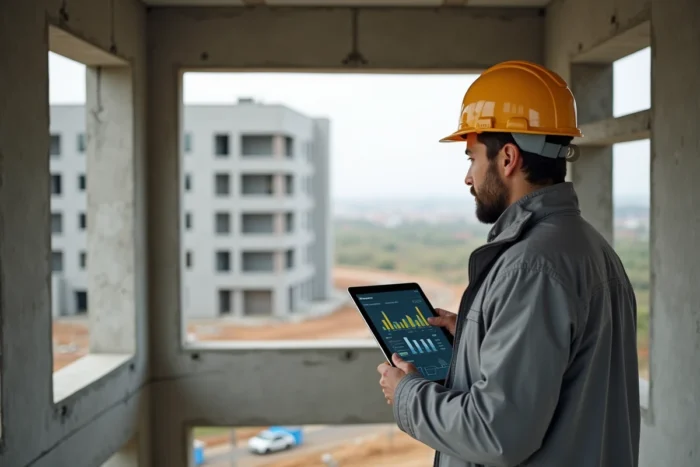
Coordination of Stakeholders and Cost Control in Complex Operations
A professional real estate operation rarely involves fewer than ten stakeholders: project manager, technical study offices, construction companies, diagnosticians, notaries, insurers, local authorities. The coordination of these actors determines adherence to the budget and timeline.
The role of the project manager (or project management assistant) is to maintain a cross-sectional view that each stakeholder, focused on their specific task, cannot have. This vision includes:
- Real-time budget tracking, with identification of deviations before they crystallize into amendments
- Management of interfaces between trades, the main source of delays in renovation or development projects
- Documentary traceability, which has become critical with the tightening of compliance obligations (DPE, accessibility, fire standards)
Without this centralized management, professionals regularly encounter budget overruns and schedule slippages that erode the projected profitability of the operation.
Risk Analysis from the Outset
One of the least visible contributions of project management support concerns risk analysis prior to launch. Identifying probable bottlenecks (easements, third-party appeals, technical hazards on existing structures) before financial commitment allows for adjustments to the setup or, in some cases, to abandon an operation whose risk profile does not justify the investment.
This ability to say no, or to restructure a project before it becomes irreversible, distinguishes professional support from mere construction site monitoring.
The professional real estate market is entering a phase where regulatory constraints (DPE, climate resilience, taxation) overlap and accelerate. Operations that succeed on time and within budget are those whose management was planned before the first shovel hit the ground, not after the first problem arose.