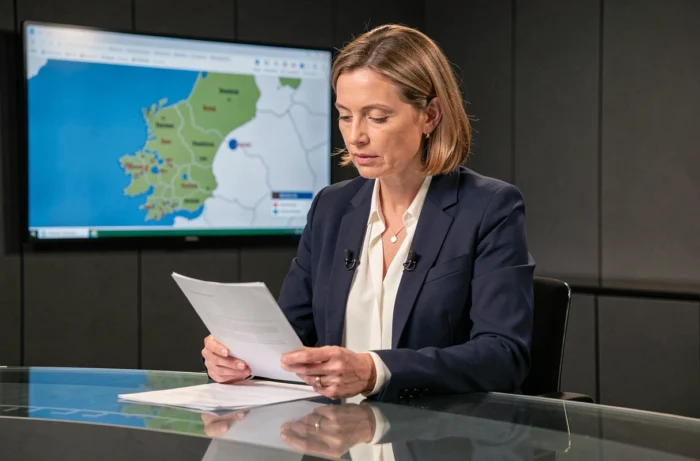
The last week of September 2026 will be marked in Brittany by an unusual convergence: a widespread hydrological crisis, climate mobilizations in several cities, and the announcement of regional financial measures for the agricultural sector. These three sequences, taken together, paint a more complex picture than the simple drought alerts relayed throughout the summer.
Drought in Brittany: a hydrological crisis that goes beyond water restrictions
At the beginning of September, the Regional Directorate for the Environment, Planning and Housing (DREAL) of Brittany classified almost the entire region as being in a “crisis” situation, with the exception of the islands of Morbihan. This update, confirmed on September 19, specified that precipitation forecasts remained insufficient to improve the situation in the short term.
In Ille-et-Vilaine, the prefecture ordered the temporary closure of car wash stations. The operators of these facilities, faced with a sudden halt in their activities, publicly expressed their distress. One manager summarized the situation with a phrase quoted by France Info: “We can’t hold on for another 30 days.”
Following the news from France Info Bretagne allows us to gauge how the crisis exceeds the framework of domestic restrictions: water bodies in severe degradation, municipalities historically rich in water resources now subject to limitations, and groundwater levels at their lowest for the season.
Brittany’s farms and climate adaptation: the true cost of drought
Reports on the prefectural orders tell only part of the story. Behind the scenes, the drought is reshaping the economic model of Breton farms. Cerfrance Bretagne, a management firm that supports a large portion of regional farms, detailed the extent of the problem in an interview published by Ouest-France on September 18.
The observation is straightforward: drought has caused a significant deterioration in the economic outlook for livestock farms. Without sufficient forage, farmers must purchase animal feed at high prices or reduce their herds, both options that compress margins over several accounting periods.
Region-backed loans: a safety net, not a structural solution
To address the urgency, the Brittany Region announced during the SPACE (animal production fair) a scheme for guaranteed loans for farmers. This fund adds to the 6 million euros in additional aid revealed at the same time.
The mechanism relies on a regional guarantee that facilitates access to bank credit. It allows farms to get through cash flow challenges without hastily selling off assets (land, livestock, equipment). Field feedback on this point varies: some unions find the amount appropriate for the urgency, while others believe that loans, even guaranteed, merely postpone the problem if droughts recur.
- Dairy farmers and forage producers are among the most exposed sectors, as their model depends on regular rainfall between May and September.
- The question of irrigation, historically marginal in Brittany, is beginning to appear in regional decisions, with no consensus on the volumes that can be mobilized.
Climate marches in Brittany: rural and urban mobilization on September 26
On Saturday, September 26, more than 250 climate marches were organized across France. Brittany was no exception: eight gatherings were announced in Ille-et-Vilaine, including a full day in Rennes combining a picnic, popular forum, and demonstration.
A notable aspect this week is the rural dimension of the mobilization. Marches took place in municipalities that had never hosted such events, a sign that the visible drought (dry rivers, daily restrictions) has shifted the climate issue from a militant register to a concrete one.

Visit of Pope Leo XIV: Brittany between fervor and giant screen
Another sequence of the week, unrelated to the water crisis but closely followed in Brittany: the visit of Pope Leo XIV to France. While the papal mass took place outdoors at Place de la Concorde in Paris, nearly 400 faithful gathered at the basilica of Sainte-Anne-d’Auray to follow the ceremony on a giant screen.
The choice of Sainte-Anne-d’Auray is not trivial. The Morbihan sanctuary remains the main pilgrimage site in Brittany and regularly hosts broadcasts of papal events. The choir from the commune, which led the celebration in Paris, strengthened the symbolic link between Brittany and this visit.
Politics and society in Brittany: mobilizations of the week
Beyond climate and drought, the week was marked by several mobilizations. High school students from Quessoy, in Côtes-d’Armor, spoke out in a France 3 report to contest the image of “forgotten rural youth,” claiming a chosen local anchorage.
The week of September 26, 2026, in Brittany cannot be reduced to a list of regional news items. The drought, due to its duration and intensity, has shifted several issues from the environmental register to the economic and political register. The financial decisions of the Region, citizen mobilizations, and the silent transformation of farms outline a return where climate is no longer a distant subject, but the common thread of Breton news.