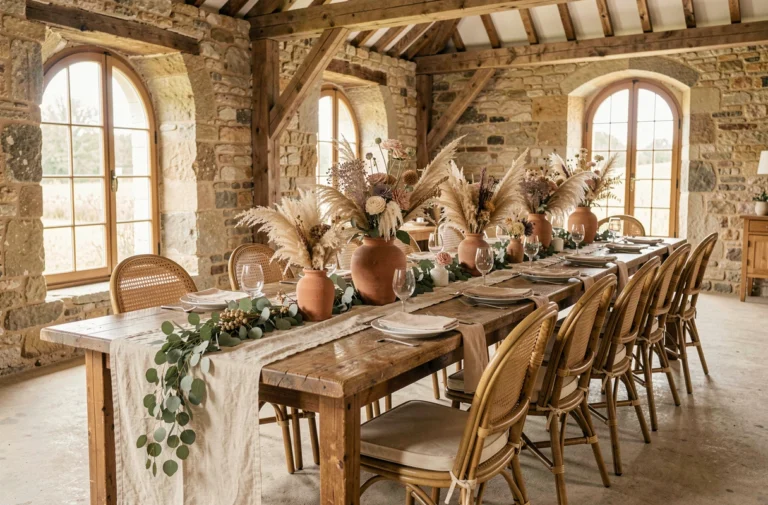
Furnishing a house in Madagascar presents a unique equation: abundant local materials, a furniture offering that has been developing over the past few years, but logistical and climatic constraints that influence every choice. This article compares the main options available for decoration and interior design on the Big Island, drawing on recent developments in the Malagasy market.
Furniture and Decor Offering in Madagascar: Local Artisans vs. Structured Brands
The Malagasy interior design market has long relied on two pillars: local carpenters and imported goods by the container. Since 2022, the establishment of the BUT Madagascar group (showrooms in Antananarivo and Toamasina) has introduced a third channel, with standardized ranges, in-store advice, and displayed prices.
The Makadam workshop, listed on the Zoma platform, illustrates another trend: Malagasy creators offering contemporary furniture made locally, often from rosewood or woven raffia.
| Criteria | Local Artisan | Structured Brand (e.g., BUT) | Malagasy Creator (e.g., Makadam) |
|---|---|---|---|
| Customization | Very high (made to measure) | Low (fixed ranges) | Medium (limited collections) |
| Delivery Time | Variable, sometimes long | Immediate stock in showroom | Several weeks |
| Warranty / After-Sales Service | Informal | Structured | Variable depending on the workshop |
| Materials | Local solid wood | Panels, metal, mixed | Noble wood, natural fibers |
| Price | Negotiable, often competitive | Fixed, mid-high segment | Mid to high segment |
The resources available on the Gasy website for home allow users to identify active suppliers by category and city, facilitating comparison before making a move.
Natural Malagasy Materials: Wood, Raffia, and Stone for Interior Design
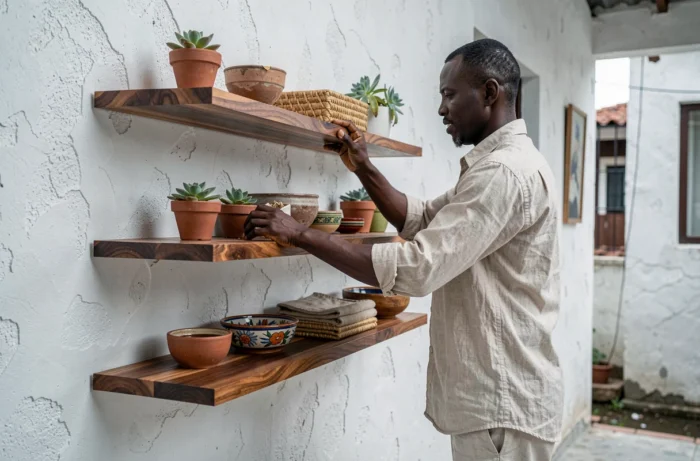
Wood remains the dominant material in construction and decoration in Madagascar. Rosewood, long overexploited, is now subject to restrictions. In contrast, species such as eucalyptus, reforested pine, or hazomalania are more accessible and suitable for both frameworks and furniture.
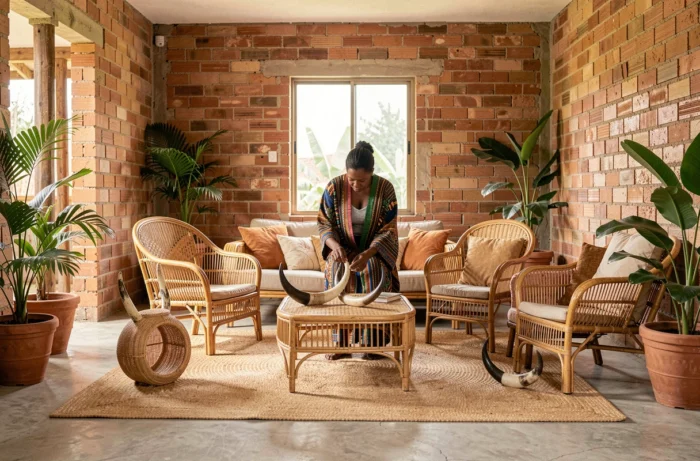
Malagasy raffia offers a rare versatility in decoration. Used for wall coverings, rugs, lampshades, or partition panels, it adds texture and light sound insulation. Artisans from the Highlands weave custom pieces at prices significantly lower than imported equivalents.
Stone and Laterite for Cladding
Laterite, the characteristic red earth of the Highlands, serves as a base for naturally tinted wall coatings. Some Malagasy interior architects use it to create accent walls without resorting to industrial paint.
Local stone (granite, gneiss) works well for kitchen countertops or bathroom cladding, provided that appropriate waterproofing treatment is applied for the humid climate of the East Coast.
Lighting and Natural Ventilation: Adapting Decoration to the Malagasy Climate
Natural light in Madagascar is abundant for much of the year. Taking advantage of this resource reduces lighting costs and radically changes the interior atmosphere. Two concrete levers deserve attention.
- Orientation of openings: north-facing windows capture light without excessive overheating, limiting the need for blackout curtains and allowing the textures of walls and furniture to shine
- Wood or woven raffia screens: these panels filter light while ensuring ventilation, a compromise suitable for coastal areas where humid heat makes closed rooms uncomfortable
- Light paint on interior walls (off-white, cream, sand): it amplifies natural brightness and highlights decorative objects made of dark wood or plant fibers
For artificial lighting, warm temperature LED bulbs better replicate the ambiance of natural materials than the white fluorescents still very common in Malagasy hardware stores.
Cross Ventilation and Room Layout
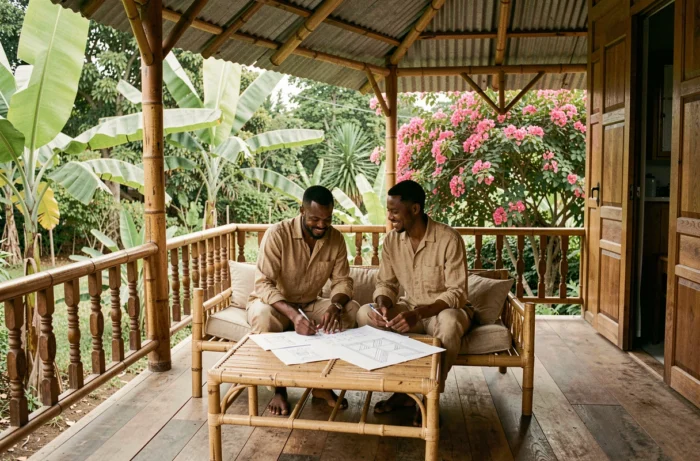
In houses on the East Coast (Toamasina, Mananjary), cross ventilation conditions comfort far more than decoration. Placing tall furniture (wardrobes, bookshelves) perpendicular to air flows, rather than against load-bearing walls, prevents blocking circulation. This detail in layout has a direct impact on the durability of upholstery fabrics and wood, which suffer less from stagnant humidity.
Land Security and Investment in Homes in Madagascar
Investing in interior design requires a minimum level of security regarding the property itself. In August 2026, the Constitutional High Court declared the law n°2026-008 on the private real estate domain of the State to be in accordance with the Constitution. This text clarifies the rules for the transfer of public lands and should ultimately reassure owners who were hesitant to undertake renovation or heavy decoration work on properties with unclear status.
This legal evolution does not change practical decoration advice, but it alters the economic calculation. A secured land title justifies a more substantial investment in interior design, whether it involves laying natural stone flooring or installing a fitted kitchen.
The Malagasy decoration market is rapidly structuring itself, between imported brands and local creators who enhance the fibers and woods of the country. The determining factor remains less the decoration budget than the consideration of climate and land security, two parameters that condition the durability of each design choice.