
We arrive for a consultation with a printed grid from the day before, and at the moment of scoring the first item, we realize that the numbering does not match that of our colleague. The final score differs, and the follow-up loses its coherence. This scenario often occurs when we retrieve a PDF of the Tinetti test randomly from the web.
Several French versions circulate with differences in wording, layout, and sometimes even the number of items. Finding a reliable version that conforms to the original scale of Mary Tinetti requires a minimum of verification before printing anything.
PDF Versions of the Tinetti Test: Why They Are Not All Equal
The Tinetti test (POMA) is based on 16 items divided into 9 balance items and 7 gait items, for a maximum score of 28 points. This is the structure published by Mary Tinetti in 1986, and it is the one that must appear on any PDF used in clinical settings.
In practice, online we find grids from sites like SGCA, Fullphysio, Maeker, or the Belgian INAMI. All announce a total of 28 points, but the wording of the scoring criteria varies from one source to another. Some grids rephrase the observation instructions, others change the order of the items or add annotations that can be confusing during administration.
Before downloading anything, we check three elements. The document contains 16 distinct items. The balance score caps at 16 and the gait score at 12. The scoring criteria use an ordinal scale with three levels (0, 1, and 2) for each item. If any of these points do not match, we move on to the next PDF.
A recent guide also offers a structured checklist to apply before any use at the patient’s bedside: confirmation of the original version, traceability of the administration conditions (time, technical assistance used, cognitive state of the patient), and verification of the maximum score. Notably, the Tinetti test PDF on Seniors Actu includes these detailed compliance markers.

Download the Free Tinetti Test PDF: Reliable Sources in 2026
Rather than listing twenty links, let’s focus on sources that offer a compliant and directly usable PDF.
- The SGCA website (sgca.fr) provides a downloadable PDF for free, structured in two parts (balance and gait) with the 16 items and the scoring scale out of 28. The file is accessible without account creation.
- Maeker (maeker.fr) includes the grid in a broader geriatric evaluation sheet. The PDF features the 9 balance items and the 7 gait items presented in a table format, facilitating quick scoring.
- Fullphysio offers a preview of the grid, but the complete download requires a login to an account. The version is compliant, but access is not entirely free.
Feedback varies on the quality of layout depending on browsers and printers. A PDF designed for A4 format with sufficiently wide scoring boxes avoids input errors in the field. We prefer files that leave space to note the conditions of administration (date, technical assistance, free observations).
Beware of Modified or Incomplete PDFs
Some documents shared on forums or social networks are screenshots converted into PDFs. The resolution is poor, items may be truncated, and the total score displayed does not always correspond to the sum of the sub-scores. Always check the consistency between the number of items and the announced maximum score.
Interpreting the Tinetti Score to Assess Fall Risk
A high score on the Tinetti test indicates a low risk of falling, which is the opposite of some geriatric scales where a high number signals danger. This peculiarity often traps caregivers who are new to the tool.
The commonly used interpretation thresholds are as follows:
- Above 24 points: fall risk considered low
- Between 19 and 24 points: moderate fall risk requiring monitoring and targeted preventive measures
- Below 19 points: high fall risk, rapid preventive management recommended
These thresholds serve as guidelines, not verdicts. The score makes sense when combined with the patient’s fall history, medication treatment, and cognitive abilities. A patient scoring 22 points while on psychotropics does not present the same profile as a patient scoring 22 points without sedative treatment.
Conditions for Administering the Tinetti Test: What Affects the Result
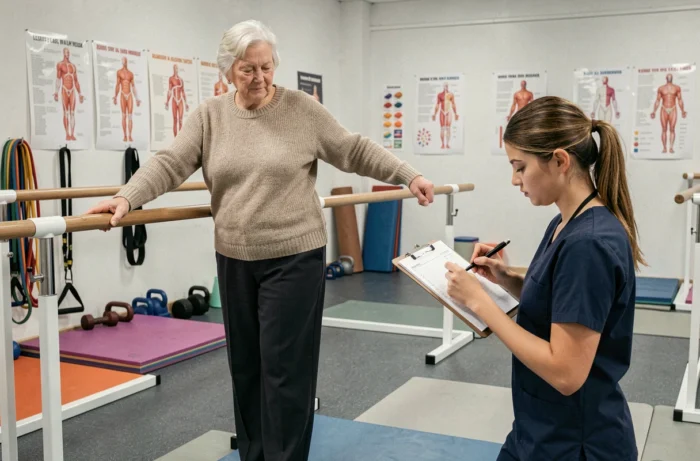
The test requires no sophisticated equipment: a rigid-backed chair and the patient’s usual technical assistance are sufficient. The administration lasts about five minutes. However, several parameters directly influence the obtained score.
The time of administration matters. A patient evaluated in the early morning, well-rested, does not produce the same result as in the late afternoon after several hours of standing. If using the test for longitudinal follow-up, the same conditions should be replicated from session to session.
The type of shoes worn affects gait and balance. Slippery hospital slippers skew the scoring compared to the closed shoes the patient wears at home. This detail is systematically noted on the sheet.
The cognitive state of the patient at the time of the test also deserves to be recorded. A temporary confusion, anxiety related to the unfamiliar environment, or acute pain can alter performance without reflecting the usual level of risk. Documenting these elements on the printed PDF ensures a usable follow-up from one evaluation to the next.
The Tinetti test remains a screening tool, not a comprehensive assessment of mobility. It fits into a broader standardized geriatric evaluation alongside other tools like the Timed Up and Go. Having a compliant and correctly filled PDF is the first building block of a long-term fall prevention follow-up.