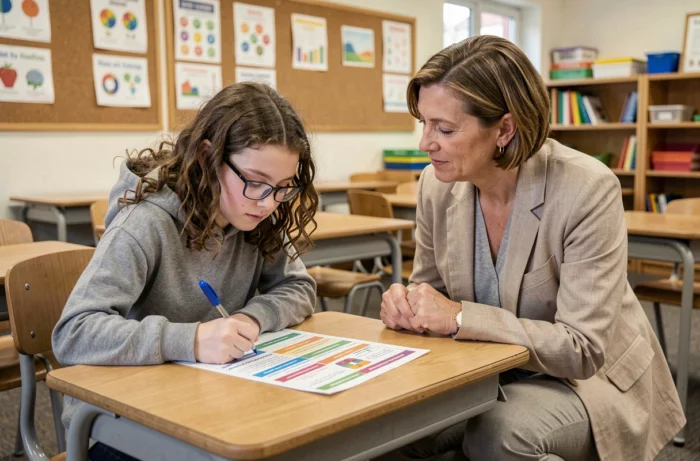
Specific learning disorders (dyslexia, dyspraxia, dyscalculia, dysorthographia, dysphasia) affect cognitive functions related to language, movement, or calculation. Their management in regular classrooms is no longer limited to individual accommodations: the measures planned for the start of the 2026 school year aim for a structural adaptation of the school environment, from the physical organization of the classroom to the digital tools made available to teachers.
Self-Regulation Rooms: A Concrete Lever for Dys Disorders in Class
Self-regulation measures, long reserved for students with autism spectrum disorders in primary school, have been updated. Their scope now includes dyslexia, dyspraxia, and dyscalculia. The deployment is no longer limited to primary education: middle schools and general, technological, and vocational high schools are also concerned.
The principle is based on a dedicated physical space, distinct from the main classroom. A student who feels cognitive overload or has difficulty concentrating can go there to use targeted strategies (attention management, emotional regulation, refocusing exercises). Returning to class is done without interruption of the lesson.
This approach modifies the usual logic. Instead of asking the dys student to compensate for their difficulties alone with extra time or an adapted font, the environment itself integrates a support mechanism. The support for dys students in my class 2026 complements these measures by documenting the educational resources accessible to educational teams.
Continuous Training for Teachers on Learning Disorders
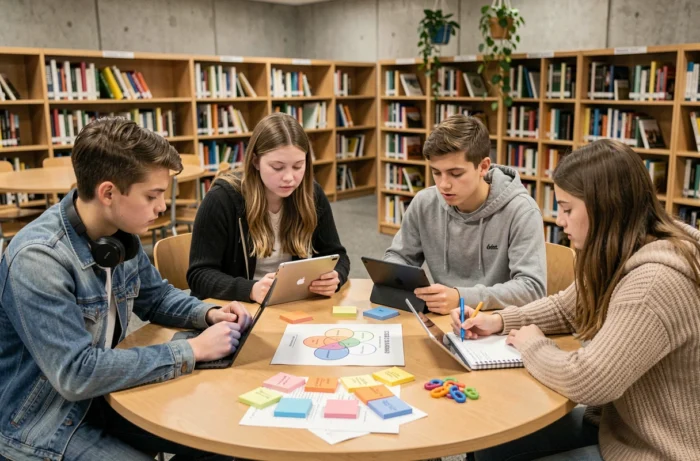
An accommodation, no matter how well thought out, remains ineffective if the teacher does not know how to activate it at the right moment. The 2026 trend is no longer limited to providing tools: it shifts the focus towards continuous training for educational teams.
Specifically, training a teacher to identify a dys disorder does not simply involve presenting them with a list of symptoms. Three distinct skills come into play:
- Identifying early signals of a specific disorder (recurring confusion of mirror letters, persistent difficulty in associating a sound with a grapheme, disproportionate slowness in copying).
- Adapting educational materials in real-time (rephrasing a complex instruction into several short steps, offering an audio support in addition to written material, reducing the amount of information on a page).
- Coordinating classroom work with institutional measures (PAP, PPS, PPRE) without the administrative burden becoming a barrier to differentiation.
A trained teacher changes the dynamics of the entire class. Adaptations designed for a dyslexic student (oral instructions, clear layout, task segmentation) also benefit students without a diagnosis who struggle with reading or comprehension.
Digital Complementarity and Paper Accommodations for Dys Students
Inclusive schooling in 2026 no longer relies solely on accommodations documented in a formal plan. Digital tools add a functional layer that did not exist in previous measures.
Audio reading of instructions exemplifies this evolution. A dyslexic student who struggles with decoding a written statement can listen to the instruction read aloud by an integrated tool. The gain is not about ease, but about access: the student processes the cognitive content of the exercise instead of expending all their energy on decoding.
The specific formatting of materials (increased spacing between lines, reduced serif font, syllabic coloring) complements the paper aspect. These two approaches are not mutually exclusive. The same student can benefit from a reformatted document on screen for discovering a text, and then work on an adapted paper support for the application exercise.
What Digital Does Not Replace
The digital tool does not correct a dys disorder. It reduces the barrier to accessing content. Remediation remains the responsibility of professionals (speech therapists, occupational therapists, school psychologists). Confusing compensation with rehabilitation leads to over-equipping a student with tools without addressing the underlying difficulty.
Continuity of Educational Path: From Individual Plan to Institutional Logic
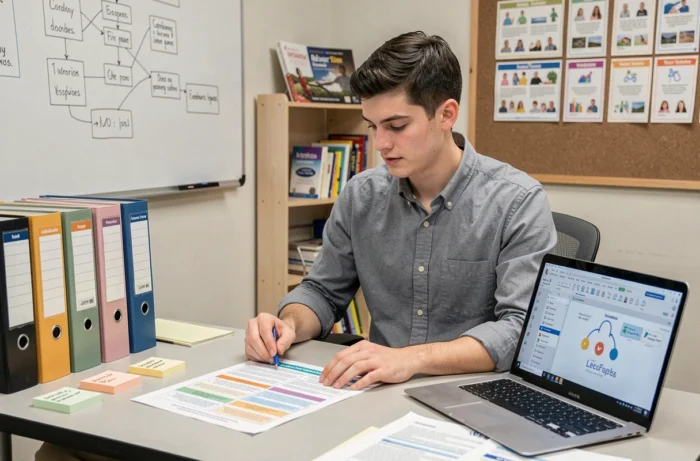
The framework emerging for 2026 emphasizes a point that previous measures poorly addressed: the continuity of the educational path between school levels. A dys student benefiting from a PAP in CM2 often found themselves without effective accommodations in the first weeks of sixth grade, while the new middle school reviewed the file.
The logic is evolving towards a gradual elimination of breaks in support. Reasonable adjustments and assistive technologies follow the student, not the institution. The transfer of information between educational teams becomes a quality criterion for the inclusive measure.
This continuity also benefits families. Parents who had to reformulate their child’s needs each year to a new team gain clarity. The support plan, whether a PAP or a PPS notified by the MDPH, functions as a living document that travels with the student.
Impact on the Regular Classroom
When an institution structures its inclusive policy on a collective scale, the benefits extend beyond the scope of diagnosed students. Universal pedagogical practices benefit all students: segmenting instructions, varying presentation channels, allowing time for rephrasing. These practices do not require a diagnosis to be implemented.
The 2026 classroom does not invent school inclusion. It formalizes what teachers were already doing in isolation, providing them with a framework, dedicated spaces, and training that goes beyond mere awareness. The real change is measured when a dys student transitions to a new level without losing their accommodations.