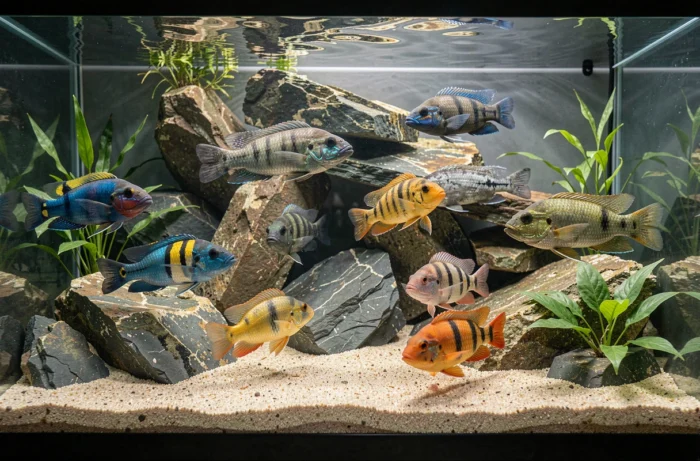
Cichlids form one of the most diverse families of freshwater fish in the world. Their range of colors, territorial behaviors, and parental care make them a unique group in aquarium keeping. Comparing the requirements of the main species allows for a clear understanding of the differences between a tank of South American dwarf cichlids and an aquarium replicating the biotope of a large African lake.
Water parameters compared by cichlid origin
The choice of a cichlid species primarily depends on the water chemistry available to the aquarist. The differences between African and South American biotopes are significant, and ignoring them leads to chronic health problems.
| Origin / Biotope | Recommended pH | Hardness (GH) | Temperature | Minimum volume |
|---|---|---|---|---|
| Lake Malawi (Mbunas) | 7.8 – 8.5 | High (hard water) | 24 – 28 °C | Large tank (several hundred liters) |
| Lake Tanganyika (Neolamprologus, Tropheus) | 7.8 – 9.0 | Very high | 24 – 27 °C | Variable depending on species |
| South America (Angelfish, Discus) | 5.5 – 7.0 | Low (very soft water) | 26 – 30 °C | Large tank, significant height |
| Dwarf cichlids (Ramirezi, Apistogramma) | 5.5 – 7.0 | Low to medium | 25 – 29 °C | Modest tank (from a few tens of liters) |
This table highlights a often underestimated point: An African cichlid and a South American cichlid share almost no water parameters. Mixing them in the same tank compromises the health of one or the other.
For more in-depth taxonomy and species profiles, a useful resource is: https://cichlidae.be/, which lists a large number of updated scientific descriptions.
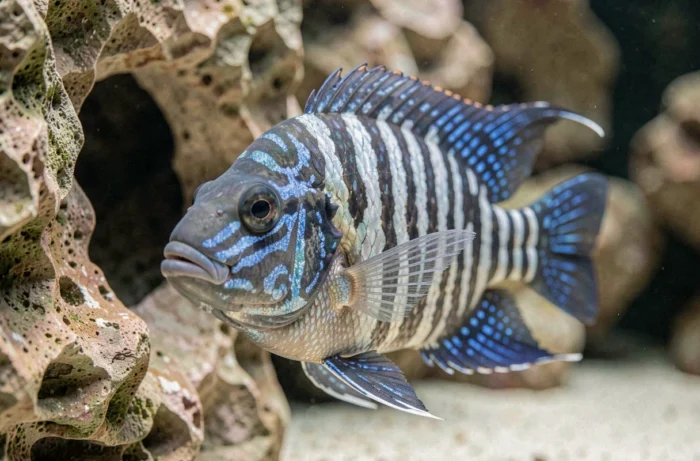
Territorial behavior of cichlids and tank setup
Most competitors list popular species without detailing the concrete management of aggression. Yet, this is the factor that causes the most losses in a cichlid aquarium.
Controlled overpopulation in Malawi Mbunas
Mbunas (Pseudotropheus, Labidochromis, Melanochromis) defend a rocky territory with an intensity disproportionate to their size. The technique of controlled overpopulation, widely documented by experienced aquarists, involves maintaining a high number of individuals to dilute aggression. The fewer the fish, the more violence concentrates on a few targets.
This approach requires oversized filtration and frequent water changes. The decor should provide numerous rocky hiding places, with broken lines of sight to limit pursuits.
Dwarf cichlids: localized territoriality
The Ramirezi or Apistogramma occupy a restricted territory around a spawning site. However, they tolerate full-water roommates (small characins, corydoras) as long as they do not venture into the breeding area. A pair of Ramirezi actively defends a radius of a few tens of centimeters around their nest.
The fundamental difference with Mbunas lies in the necessary volume: a pair of dwarf cichlids thrives in a well-planted tank of modest volume, whereas Malawi species require a much larger rocky space.
Cichlid feeding: what the label doesn’t say
Commercial foods labeled “cichlids” cover too broad a spectrum to be reliable without verification. Nutritional needs vary radically according to the natural diet of each group.
- Mbunas are primarily herbivorous and graze aufwuchs (micro-algae and microorganisms attached to rocks). An excess of animal protein causes “Malawi bloat,” a often fatal digestive syndrome.
- Discus and Angelfish are omnivorous with a carnivorous tendency. They accept brine shrimp, bloodworms, and protein-rich pellets without comparable digestive risks.
- Cichlids from Tanganyika have very varied diets depending on the genus: Tropheus are strict herbivores, while Neolamprologus hunt invertebrates.
Feeding a Tropheus like a Discus can kill it within weeks. Feeding is the most common trap for aquarists starting with multiple cichlid species.

Regulations and vigilance before buying cichlids
General articles rarely touch on a point that has become significant in recent years: the verification of the regulatory status of each species by its scientific name, and not by its commercial name. Regular updates of lists of species subject to restrictions (CITES, national regulations) require sellers and individuals to check the exact nomenclature before any acquisition or importation.
Releasing into the wild is strictly prohibited in France, regardless of the species’ status. This rule applies to all aquarium fish, including cichlids, even those considered common in trade.
For species listed in CITES annexes, importation from a third country requires specific permits. The majority of common cichlids from Malawi or Tanganyika do not appear on these lists, but some rare or endemic species may be added during periodic revisions. Checking CITES status before purchasing a rare specimen avoids administrative penalties.
Cichlid reproduction: mouthbrooding vs. substrate spawning
Two reproductive strategies dominate among cichlids, and they dictate the tank setup.
Mouthbrooders (the majority of Malawi species and some from Tanganyika) keep the eggs and then the fry in the female’s mouth for several weeks. The female does not feed during this period. Isolating the incubating female in a quarantine tank reduces stress and increases fry survival rates.
Substrate spawners (Ramirezi, Pelvicachromis, Neolamprologus brichardi) lay their eggs on a flat surface or in a cavity. Both parents participate in guarding. This cooperative parental behavior is one of the most elaborate among freshwater fish and is a major attraction for aquarium observation.
The choice between these two modes of reproduction directly influences the type of decor, the male/female ratio, and the management of grow-out tanks for the young. An aquarist wanting to breed their cichlids must adapt their setup to the reproductive mode of the chosen species, not the other way around.