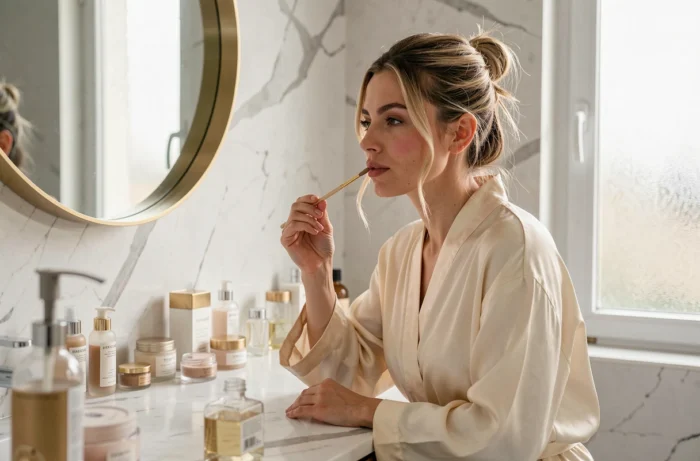
Your day cream may contain an ingredient that will be banned in less than two years. European regulations on cosmetics are tightening at a pace that most consumers are unaware of, and these changes are reshaping the formulas of your favorite products. Current beauty trends reflect a profound transformation in what is inside the bottles and how one builds their skincare routine.
European cosmetic regulation: what is changing in your beauty products
Have you ever noticed that a favorite product has changed in texture or formula without apparent explanation? The reason often lies in Brussels.
Regulation (EU) 2023/2055, which came into effect on October 17, 2023, restricts the use of synthetic polymer microparticles added to cosmetics. Deadlines range from 2027 to 2035 depending on the categories. The scope goes far beyond the exfoliating beads in scrubs: it also covers film-forming polymers in certain waterproof sunscreens, texturizing nylons in powders and foundations, and fragrance microcapsules.
More recently, Regulation (EU) 2026/78, known as Omnibus VIII, applicable since May 1, 2026, prohibits certain forms of silver (nano and bulk silver) in cosmetics. Brands have retained only a very limited use of micrometric silver powder in a few specific products like toothpaste or certain makeup items.
For those following beauty trends, these regulatory constraints force manufacturers to deeply reformulate their ranges. A waterproof mascara sold in 2024 likely does not have the same composition as one that will be on shelves in 2028. Consulting the beauty parentheses on Le Site de Julia allows you to track these changes product by product.
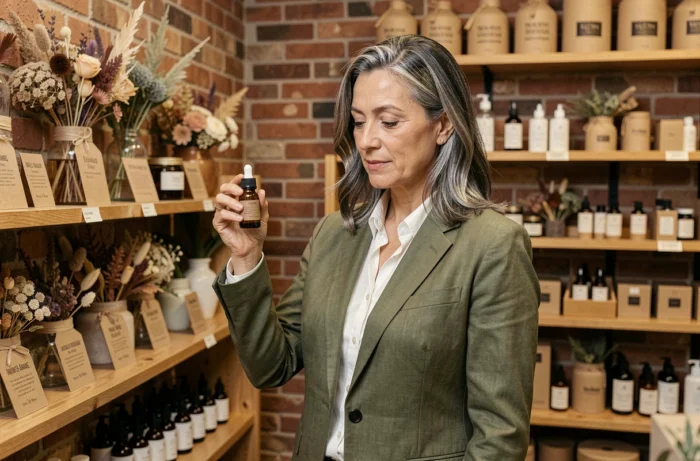
Facial care routine: fewer products, better choices
The trend towards minimalism in skincare does not come from nowhere. It stems partly from this regulatory context, but also from a simple dermatological observation: multiplying active ingredients can disrupt the skin barrier.
The principle is to reduce the number of products applied each day to keep only those that address an identified need of your skin. Three steps are often sufficient for an effective daily routine:
- A gentle cleanser suitable for your skin type (foaming gel for combination skin, milk or oil for dry skin), applied morning and night
- A concentrated serum targeting your main concern (hydration, radiance, firmness), with a single key active ingredient per formula
- A sunscreen in the morning, regardless of your skin type, because UV rays remain the primary factor in skin aging
Why this choice of simplification? Because a well-formulated and correctly dosed product works better alone than diluted in a layering of five products. A vitamin C serum loses effectiveness if mixed with too many competing actives.
Adapting your routine to the seasons
The skin does not require the same care in January as it does in July. In winter, the lipid barrier is weakened by the cold and heating. A re-lipidizing balm then advantageously replaces the lightweight cream used in summer.
In summer, sebum production naturally increases. Lightening your routine with a gel or fluid texture prevents pore overload. The constant remains sun protection, even on cloudy days.
Natural makeup and ingredients to watch for on labels
Makeup follows the same trajectory as skincare: shorter formulas, more readable compositions. Lightweight foundations and hybrid products (tinted moisturizer with SPF, pigmented lip balm) are appealing because they simplify the application while protecting the skin.

Reading the INCI list of your makeup products becomes a useful reflex. With the gradual restrictions on microplastics, some textures will evolve. Very fine powders, for example, sometimes used texturizing nylons that are now under regulatory scrutiny.
Three guidelines for analyzing a cosmetic label
- Ingredients are listed in descending order of concentration: the first five make up the majority of the formula
- Terms ending in “-one” or “-siloxane” refer to silicones, which are not banned but may not be well tolerated by some skin types
- The mention “fragrance” or “parfum” sometimes encompasses several dozen molecules, including some allergens that must be listed separately beyond a certain concentration threshold
Understanding these basics allows for informed choices without falling into the unjustified fear of all synthetic ingredients. A well-dosed synthetic preservative is sometimes safer than a poorly stabilized natural extract.
Hair care and everyday beauty: the gestures that really matter
Hair suffers from the same aggressions as the skin: pollution, UV rays, hard water. The trend towards hybrid hair care (shampoo-conditioner, express mask, multifunctional oil) meets a need for practicality without sacrificing effectiveness.
The most underestimated gesture remains rinsing. A poorly rinsed shampoo leaves residues that weigh down the fiber and irritate the scalp. Rinsing twice as long as seems necessary already transforms the quality of the result.
For the body, lightweight, fast-absorbing textures are gaining ground. They allow for immediate dressing after application, which removes the main barrier to daily hydration.
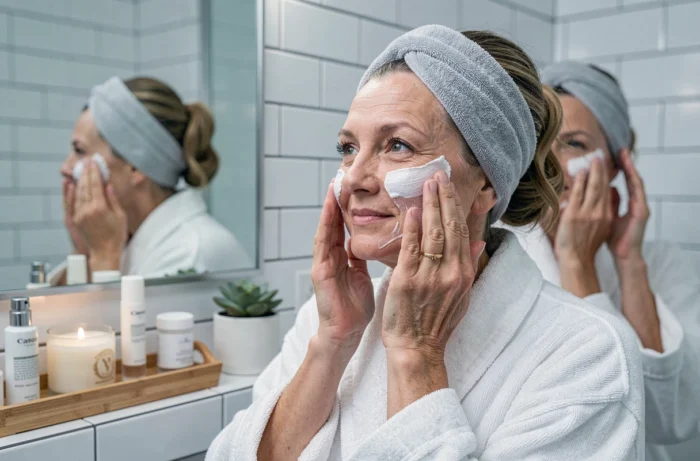
Beauty trends that last are those that address a concrete problem (dehydrated skin, polluting formula, overly long routine) and offer a solution applicable in daily life. The next time you see a product reformulation, check if it meets the new European regulatory requirements: the beauty of tomorrow is being shaped as much in the laboratories of Brussels as in beauty salons.