
A functioning garden relies on technical decisions that furniture alone does not resolve. Water management, light control, and material selection: these three axes determine the durability and comfort of an outdoor layout well before the selection of a table or garden lounge.
Rainwater Harvesting: Regulatory Framework and Tank Sizing
The decree of July 12, 2024, regarding water unfit for human consumption sets the rules. An outdoor tank supplies irrigation and cleaning, but never personal hygiene or cooking. The circuit must remain physically separate from the drinking water network, under penalty of sanctions.
Tank sizing is not just about choosing the largest available volume. We recommend correlating the collected roof area with the actual irrigation needs, taking into account the type of plants planted. A garden designed around drought-tolerant plants mechanically reduces the necessary storage volume.
During periods of drought, prefectural orders may limit or prohibit irrigation, even with rainwater. This makes drip irrigation combined with thick mulching significantly more relevant than a traditional oscillating sprinkler. Organic mulching (wood chips, hemp straw) reduces evaporation and protects the microbial life of the soil, two functions that a simple irrigation timer does not fulfill.
To select a tank, a suitable filtration system, or a drip kit, Tradition Jardin’s equipment covers these categories with references sized for different garden areas.
Outdoor Lighting: Compliance, Light Pollution, and Color Temperature Choice
The decree of December 27, 2018, regulates light pollution and directly concerns residential installations. A poorly oriented spotlight towards the neighboring property can constitute a significant nuisance, with possible recourse to the court.
The first technical decision concerns color temperature. Cool white LEDs (above 4,000 K) disrupt nocturnal wildlife and create harsh lighting. For a garden, we recommend warm white sources, under 3,000 K, which preserve visual comfort without spilling over into the neighborhood.
The choice between solar and wired lighting depends on usage. Solar is suitable for pathway markings and decorative atmospheres. For a dining area or a main circulation zone, a buried low-voltage circuit offers stable power and superior lifespan.
Motion detectors, often presented as the universal solution, pose a concrete problem: unexpected triggering by local wildlife or moving branches makes lighting unpredictable and potentially bothersome for neighbors.
Positioning of Light Sources
Downlighting limits light pollution. We observe that low bollards, between 40 and 60 cm in height, produce better results than a high spotlight for marking a pathway without glare. A dimmer or programmable timer allows for automatic shut-off after a certain hour, which remains the most reliable method to comply with regulations.
Structural Materials for Garden Furniture: Steel, Wood, or Aluminum
The choice of material determines maintenance frequency, UV resistance, and behavior against humidity. Each option imposes specific compromises.
- Epoxy-treated steel: robust and stable in the wind, but prone to chipping. A steel lounge requires a touch-up of paint every two to three years in humid climates, more so by the sea.
- Certified wood (acacia, eucalyptus, black locust): natural aesthetics and good durability provided a saturator is applied once or twice a year. Teak remains the benchmark for resistance, but its cost often leads to acacia, which offers a more accessible quality-price ratio.
- Aluminum: lightweight, corrosion-resistant, and requires almost no maintenance. However, it heats up quickly in direct sunlight and lacks mass against the wind. An aluminum lounge often requires weighting or anchoring to the ground in windy areas.
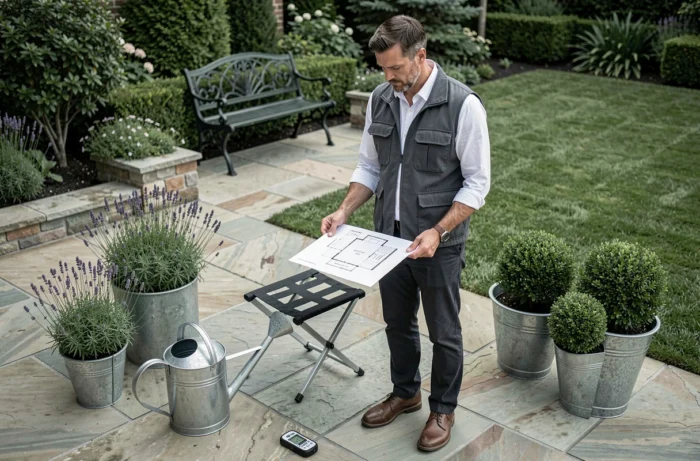
A criterion often overlooked is compatibility with the ground. On a composite wood terrace, metal feet without pads scratch the surface within weeks. On a lawn, heavy furniture creates compression zones that yellow the grass. Wide pads or distribution slabs solve these two problems at a negligible cost.
Structuring the Garden Space: Pergola, Plant Partitioning, and Flooring
A functional layout separates usage areas without visually partitioning. A wall-mounted or freestanding pergola creates a shaded dining area and structures the transition between indoors and outdoors. Made of thermally coated aluminum, it requires no structural maintenance. In wood, it gains style but requires regular treatment.
Plant partitioning advantageously replaces rigid screening panels. Tall grasses (miscanthus, pennisetum) or a mixed hedge with evergreen foliage filter the wind, reduce noise, and provide a gradual visual screen. The advantage over a lattice: no wind resistance, no maintenance of fixings, and an appearance that improves over time.
The flooring deserves as much attention as the furniture. A natural stone paving laid on a draining sand bed evacuates water without runoff. Stabilized gravel (honeycomb + gravel) offers a permeable and more accessible alternative, suitable for pathways and relaxation areas.
An elegant and functional garden is built on these structural choices, not on the accumulation of accessories. Water sobriety, light control, and material durability determine whether a layout ages well or becomes a source of constraints by the second season.