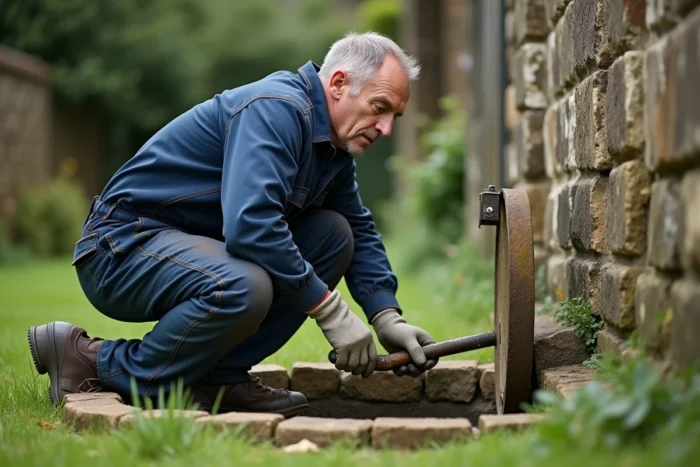
Septic tanks installed before the year 2000 still equip a significant portion of individual French homes. These buried tanks, designed to receive only the wastewater from toilets, rely on a principle of sedimentation and anaerobic digestion that has not changed since their installation. However, their operating scheme remains poorly understood by many homeowners, complicating routine maintenance and delaying decisions to bring them up to standard.
Sedimentation and anaerobic digestion: what really happens in the tank
The principle of an old septic tank relies on two simultaneous mechanisms. Solid materials fall to the bottom of the tank by gravity and form a layer of sludge. Fats and light elements rise to the surface to form a scum layer.
Between these two layers, a zone of relatively clarified water is maintained. It is this intermediate water that flows towards the drainage system or the leach pit located downstream. Anaerobic bacteria slowly digest the sludge accumulated at the bottom, which reduces its volume but produces gases (methane, hydrogen sulfide) that must be evacuated through ventilation.
Ventilation is, in fact, the element most often absent or degraded in older installations. A vertical pipe, connected to the tank or the outlet pipe, allows gases to escape through the roof. Without this extraction, the overpressure in the tank disrupts sedimentation and generates odor backflows into the house.
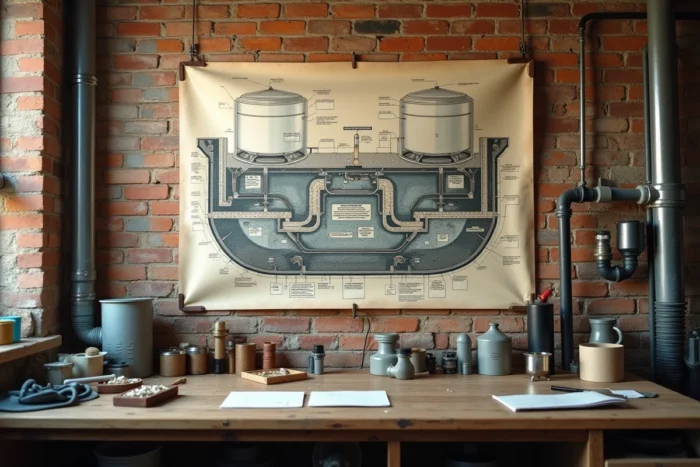
To precisely identify each component of your installation, consulting the diagram of an old septic tank helps locate the position of the tank, the inlet and outlet baffles, and the drainage network to the ground.
Ventilation and baffles: the two weak points of pre-2000 tanks
In period diagrams, two elements systematically appear but pose problems on the ground: the baffles (or siphon walls) and the ventilation duct.
The baffles are internal walls placed at the entrance and exit of the tank. Their role is to direct the flow downwards to prevent incoming water from pushing the sludge or scum directly towards the outlet. In tanks made of poured concrete on-site, these baffles crack or detach over time. A broken baffle causes a hydraulic short circuit: undecomposed materials go directly to the drainage system and clog it.
The ventilation duct is sometimes absent in the oldest installations. When it exists, it is often blocked by an ill-sized old chimney cap or by insect nests. Field reports vary on the actual frequency of this defect, but sanitation technicians regularly note it during diagnostics.
Check the condition of the baffles without opening the tank
Identifying a baffle malfunction does not necessarily require opening the lid. Two external indicators guide the diagnosis:
- Abnormally dense or green vegetation above the drainage field, indicating that undecomposed organic materials are reaching the soil
- Persistent odors at the inspection manholes located between the tank and the drainage field, indicating a passage of raw sludge
- Backflows in the interior pipes during heavy rains, when the saturated tank has no buffer zone between the baffles
Maintenance of an old septic tank: pumping frequency and common mistakes
Pumping remains the central operation to keep an old septic tank functioning. Pumping is recommended as soon as the sludge reaches half the volume of the tank. In an installation that only receives wastewater from two or three people, this threshold can be reached in two to three years. For a larger household, the interval decreases.
The recent trend among sanitation professionals is to shorten pumping intervals for old installations, rather than sticking to the often-cited theoretical rhythm of four years. Aging concrete tanks lose their watertightness, and prolonged sludge accumulation accelerates the degradation of the walls.
What should never be introduced into an old tank
The anaerobic bacteria that ensure the digestion of sludge are sensitive to chemicals. Some common actions destroy the bacterial flora and block the treatment process:
- Excessive bleach kills bacteria within hours and stops fermentation
- Wipes, even labeled biodegradable, do not decompose in a tank and clog the inlet pipes
- Cooking oils and food fats thicken the scum layer and reduce the useful sedimentation volume
- Medications and solvents disrupt the bacterial balance durably, sometimes for several weeks after a single discharge
SPANC control at the time of sale: increased pressure since 2024
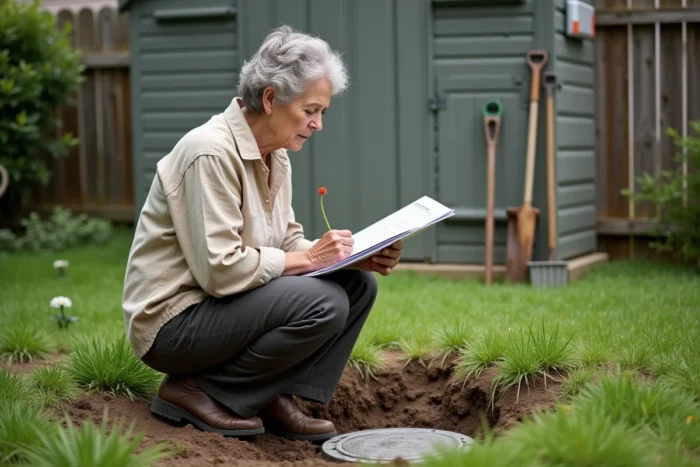
Homeowners relying on a de facto tolerance to postpone compliance face a changing context. Since 2024-2025, SPANC (Public Services for Non-Collective Sanitation) are intensifying checks during real estate transactions. A non-compliance with health or environmental hazards requires work within a year after purchase, which directly affects the negotiation of the sale price.
The sanitation diagnosis, mandatory for any sale of a property equipped with a non-collective system, must be less than three years old at the time of signing. However, its validity does not guarantee that the SPANC will not issue new reservations if the installation has deteriorated in the meantime.
For owners of an old septic tank, a minimalist maintenance strategy (pumping every five or six years, no checking of the baffles or ventilation) becomes risky. The cost of a complete replacement with a multi-water tank or a micro-station represents a significant investment, but an unfavorable diagnosis at the time of sale can lead to a much higher depreciation of the property’s price.
Keeping a maintenance log that records each pumping, each intervention, and each check remains the most reliable way to document the system’s condition. This document facilitates exchanges with the SPANC and reassures a potential buyer, even if the installation does not meet current standards.