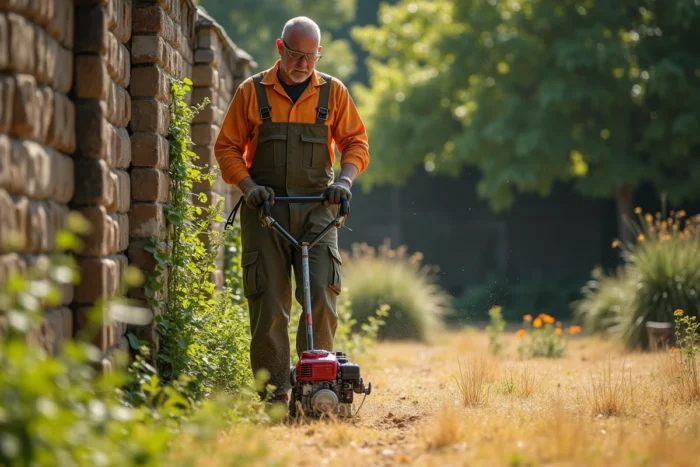
The market for thermal brush cutters remains broad, with engine displacements ranging from less than 25 cm³ for entry-level models to over 50 cm³ for professional machines. Choosing a suitable thermal brush cutter for your garden requires moving beyond the reflex of “as powerful as possible” to examine less visible criteria: the type of transmission, the bevel gear, and the compatibility of cutting systems.
The risk of sparks during dry periods is an additional factor that comparison guides rarely address.
Fire risk and thermal brush cutter: a criterion that precedes all others
Even before comparing engine displacements or brands, the question of the usage schedule deserves to be raised. Thermal engines generate heat at the exhaust level, and impacts between a metal blade and a stone can produce sparks. Therefore, the thermal brush cutter falls into a category of tools subject to usage restrictions during drought or heatwave episodes.
In departments classified as high fire risk, prefectural orders may temporarily prohibit the use of any thermal gardening or DIY equipment. Checking prefectural restrictions before each brush cutting session is not an excessive precaution; it is a legal obligation in many municipalities in southern France.
This parameter should guide the choice from the outset. If your land is located in a Mediterranean area or in a sector regularly affected by summer drought, the high-voltage battery alternative (36-40 V) deserves serious consideration, with recent field feedback indicating that these models now achieve performance comparable to thermal ones for non-professional use. The comparisons available on top-debroussailleuse-thermique.com allow you to compare these two families based on concrete criteria.
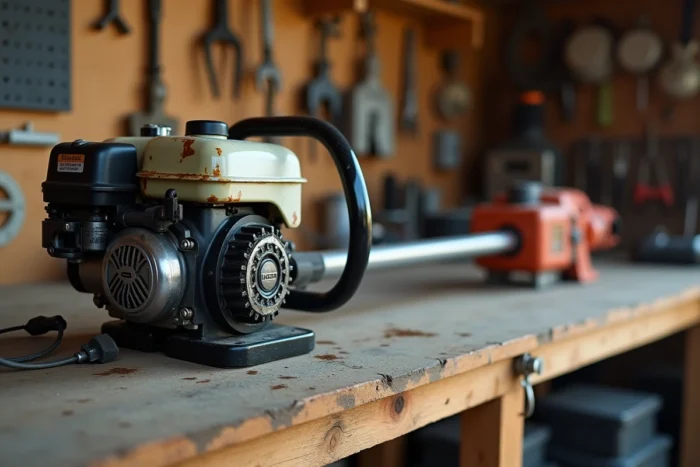
Engine displacement and bevel gear: what the technical sheet doesn’t always say
The engine displacement remains the primary indicator of cutting capacity. Field feedback varies on this point, as a high displacement does not guarantee a better result if the transmission and bevel gear do not follow suit.
Transmission and shaft: the often-overlooked link
A thermal brush cutter transmits the engine power to the cutting head via a rigid or flexible shaft housed in the shaft. A rigid shaft offers better transmission efficiency and supports heavy cutting discs, while a flexible shaft, which is rarer, is found on some entry-level models with a curved shaft.
The bevel gear, located at the junction between the shaft and the cutting head, is the part that converts vertical rotation into horizontal rotation. Its size directly conditions the robustness of the machine. On semi-professional and professional models (Stihl, Husqvarna, Echo), the diameter of the bevel gear is more generous, allowing it to support three or four-tooth blades without overheating.
2-stroke or 4-stroke engine for a garden
The 2-stroke engine dominates the segment of thermal brush cutters. It operates with a gasoline-oil mixture, offers a good power-to-weight ratio, and is less expensive to purchase. The 4-stroke engine (Honda is the main representative) consumes less, emits fewer gases, and runs more quietly, but it is heavier.
For a medium-sized garden with regular use, the 2-stroke remains the majority choice due to its lightness. The 4-stroke is more justified on large areas where fuel consumption and noise become determining factors, or if you are sensitive to user comfort during long sessions.
Cutting system: line, blade, or disc depending on the vegetation
The cutting system is the point where many buyers make a poor choice, often due to a lack of information on compatibility between the head and the engine.
- The nylon line head is suitable for tall, soft grasses. It is standard on most brush cutters and is sufficient for regular garden maintenance (edges, wild grasses along fences). The diameter of the line determines its resistance: a thin line for finishing, a thicker line for dense grasses.
- The three-tooth or four-tooth blade tackles brambles, young shrubs, and woody vegetation. It requires an engine of at least 30 cm³ of displacement and a bevel gear sized accordingly.
- The tungsten disc, reserved for heavy work (thick underbrush, small trunks), requires a professional machine with a complete safety harness and leg protectors. It is not a common gardening tool.
A common trap is to buy an entry-level brush cutter thinking of fitting a metal blade later. On many small engine models, the bevel gear and guard are not designed to support a blade, even if the mounting thread seems compatible.

Weight, handle, and harness: the comfort that determines work quality
A criterion that product sheets often relegate to the bottom of the page changes everything on the ground: the weight of the machine combined with the quality of the harness. A thermal brush cutter generally weighs between four and ten kilograms depending on the displacement. Beyond half an hour of use, every additional kilogram is felt in the shoulders and lower back.
The type of handle influences maneuverability. The bicycle-type handlebar offers symmetrical control suitable for large flat areas. The loop or D-handle allows for more precise movements in cluttered areas (around trees, along walls).
- For a large open area: handlebar with double strap harness
- For a garden with obstacles (beds, borders, slopes): loop handle with single or double harness
- For prolonged professional use: full forest harness that distributes weight on the hips
Maintenance and access to an authorized workshop: an underestimated choice factor
Choosing a brand of thermal brush cutter without checking for the presence of a dealer or authorized workshop nearby is a costly mistake. Wear parts (line, head, spark plug, air filter) are easily found for established brands like Stihl, Husqvarna, or Echo. In contrast, the local availability of parts and a qualified technician varies significantly from region to region.
A poorly adjusted 2-stroke engine consumes more, loses power, and clogs. Regular maintenance of the air filter, replacement of the spark plug, and checking the gasoline-oil mixture condition the longevity of the machine. If your nearest dealer is more than an hour’s drive away, the ability to perform this basic maintenance yourself becomes a selection criterion in its own right.
The choice of a thermal brush cutter is less about raw power than about the suitability of the machine, the terrain, and local constraints. A well-sized model, combined with the right cutting system and an appropriate harness, transforms a strenuous task into a controlled job. The proximity of an authorized workshop and knowledge of seasonal restrictions related to fire risk complete a choice that too many guides reduce to a simple comparison of engine displacements.