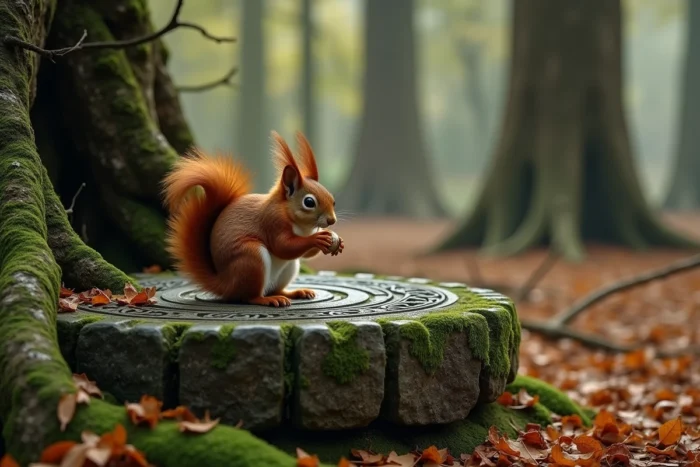
The red squirrel (Sciurus vulgaris) crystallizes in the collective imagination a set of symbols related to foresight and agility. We observe that most content on this subject remains confined to a purely mystical reading, never crossing these symbols with what the actual presence of the animal reveals about a given environment. The spiritual significance of the squirrel gains depth when confronted with its concrete ecological dimension.
Squirrel and bio-indication: what its presence really says about your environment
Before discussing spiritual messages, one fact stands out: a squirrel in a garden indicates a functional ecosystem. Its presence implies sufficient tree cover, a diversity of food resources (hazelnuts, acorns, buds, mushrooms), and moderate predation pressure.
The red squirrel is particularly sensitive to the fragmentation of wooded habitats. When it regularly appears in a domestic space, it reflects an ecological continuity between the garden and a forested area or a tree corridor. This is not trivial in a context of increasing urbanization.
We recommend reading this presence as a field diagnosis before projecting a presage onto it. A garden frequented by squirrels generally also hosts great tits, woodpeckers, and a diverse entomofauna. The squirrel acts as an indicator of good ecological health, a marker that purely symbolic articles systematically ignore.
Those interested in the spiritual significance of the squirrel would benefit from integrating this interpretative framework: the sacred dimension attributed to a wild animal is primarily based on the quality of the bond between humans and their natural environment.

Symbolism of the squirrel: beyond foresight, the balance between accumulation and letting go
The most common interpretation associates the squirrel with saving and preparation. This is an incomplete reading. The squirrel’s caching behavior does not stem from a perfectly mastered strategy. The animal forgets a significant proportion of its buried reserves, and these forgettings directly contribute to forest regeneration through germination.
The true symbol is not accumulation but the cycle of giving-forgetting-renewal. The squirrel plants trees unknowingly. In symbolism, this reflects a relationship to abundance that is not based on control, but on trust in the natural process.
This shift changes the message’s significance. When observing a squirrel bury a hazelnut in a flowerbed, the relevant symbol is not “prepare for winter” but rather “what you let go of today can sprout tomorrow without your intervention.”
Compulsive accumulation or healthy foresight: a distinction that the totem animal imposes
From a totemic perspective, the squirrel invites us to examine our relationship with resources. Three axes emerge:
- The ability to collect without hoarding, that is, to distinguish useful provision from anxious accumulation
- The acceptance of loss as a driver of renewal, since forgetting caches contributes to wood regeneration
- Trust in the abundance of the environment, which assumes a grounding in a perceived nurturing and non-hostile setting
We observe that this reading resonates particularly in contexts of mental or material overload, where the squirrel totem acts as a reminder to simplify.
Squirrel in urban environments: when spiritual symbolism meets real cohabitation
An angle absent from mainstream content concerns the concrete and sometimes problematic aspect of the squirrel’s presence near homes. The animal can cause material damage: chewed insulation, damaged electrical cables, unearthed garden bulbs. This reality does not disqualify the symbolic reading; it complicates it.
In animist traditions, an animal that settles in human space and causes friction often embodies a message of readjusting boundaries. The squirrel gnawing on a cable in an attic does not carry a message of luck. It signals a friction zone between the wild and the domestic.
No scientific consensus links the observation of a squirrel to a presage of luck or warning. This point deserves to be clearly stated. The spiritual significance attributed to this encounter falls within a personal or cultural interpretative framework, not an established causality.
Nordic mythology and the role of Ratatoskr
In Nordic tradition, the squirrel Ratatoskr runs along the world tree Yggdrasil and conveys messages between the eagle perched at the top and the serpent Nidhögg that gnaws at the roots. Its role is not that of a benevolent messenger: Ratatoskr stirs discord between the high and the low.
This myth offers a less consensual reading of the totem animal. The squirrel is not only the prudent collector or the mischievous player. It is also the agent of circulation between polarities, the one who maintains tension between opposing forces. In applied symbolism, this translates into an invitation to examine how we manage information between different spheres of our lives, sometimes fueling conflicts that we could choose not to relay.
Dreaming of a squirrel: keys to interpretation according to context
The squirrel in dreams carries variable meanings depending on the observed action. A squirrel quickly climbing a tree points to a need to gain perspective on a situation. A squirrel burying provisions relates to the relationship with material security. A dead or motionless squirrel in a dream may signal a blockage in adaptability.
- Squirrel in rapid movement: available energy, invitation to act without over-planning
- Squirrel hiding or burying: questioning what one retains or conceals
- Squirrel entering a house: interpenetration of the wild and the intimate, boundary to redefine
- Specifically red squirrel: earthly grounding, connection with the woods and seasonal cycles
These frameworks remain tools for introspection. The dream of a squirrel holds value only when connected to the dreamer’s concrete experience.
The encounter with a squirrel, whether in a dream or in a garden, draws its symbolic richness from the intersection of a spiritual reading and a naturalistic observation. A wild animal sharing our daily space poses a simple question: what place do we leave for the undomesticated living in our lives? The answer to this question may be the only true message that the squirrel carries.