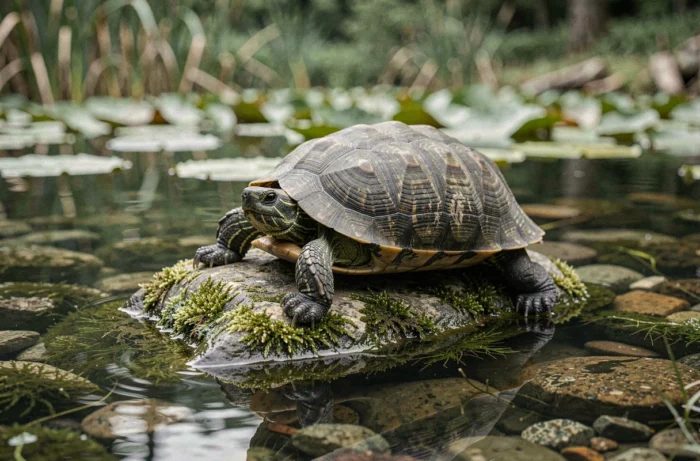
Some freshwater turtles absorb dissolved oxygen in the water through their cloaca, a unique posterior cavity that also serves for reproduction and excretion. This mechanism, called cloacal respiration, allows them to remain submerged for long periods, especially under the ice in winter, without coming to the surface to breathe.
Cloacal sacs and gas exchange: the anatomy behind the phenomenon
Talking about “breathing through the anus” is a shortcut. The area in question is the cloaca, a common opening for the turtle’s digestive, urinary, and reproductive tracts. The cloaca is not just a simple sphincter: it houses internal structures called cloacal sacs, whose walls are lined with very fine blood vessels.
The principle is similar to that of gills in a fish. The turtle takes in and expels water through rhythmic muscular contractions of its cloaca. Water flows over the walls of the cloacal sacs, and dissolved oxygen diffuses into the blood, while carbon dioxide is expelled in the opposite direction.
The breathing through the anus in turtles thus relies on specialized biological tissue, not on the digestive tract itself. This anatomical precision changes the understanding of the phenomenon: the turtle does not “breathe” with its intestines; it utilizes a richly vascularized cloacal mucosa designed to enhance gas exchange with the surrounding water.
Which turtle species practice cloacal respiration
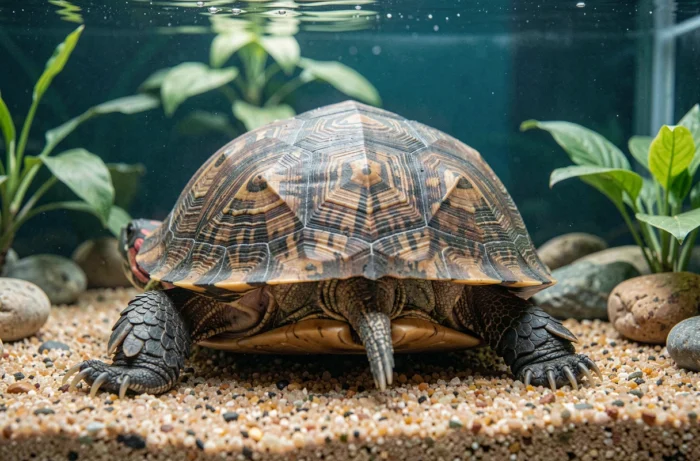
Not all turtles share this ability. Cloacal respiration mainly concerns freshwater aquatic turtles that live in rivers, lakes, or ponds in temperate regions, where winter imposes long stays underwater.
The most studied species for this adaptation belong to the Chelidae family in Australia and South America, as well as some North American freshwater turtles. The Mary River turtle (Elusor macrurus), an Australian species recognizable by the algae growing on its shell, is among the most cited examples.
- North American snapping turtles (Chelydra serpentina) use cloacal respiration to survive under the ice for several consecutive months.
- The painted turtle (Chrysemys picta) combines cloacal respiration and oxygen absorption through the skin and throat mucosa to last all winter.
- Softshell turtles (family Trionychidae) have highly vascularized skin that complements the role of the cloaca in aquatic gas exchange.
Marine turtles, on the other hand, breathe almost exclusively with their lungs and regularly come to the surface. Cloacal respiration is a freshwater adaptation, not a universal trait of turtles.
Cloacal respiration and hibernation under the ice: an inseparable pair
This mechanism becomes particularly relevant when the surface of a body of water freezes. The turtle, an ectothermic animal, sees its body temperature align with that of the water. In cold water, its metabolism slows down significantly: heart rate drops, oxygen consumption decreases, and energy needs fall to a minimal level.
Under these conditions, the cloacal sacs are sufficient to meet the oxygen needs of the resting animal. The turtle does not need to come up for air, which would be impossible anyway with a layer of ice above it.
This capacity has clear limits. If the water warms up or if the turtle needs to swim actively, the demand for oxygen exceeds what the cloaca can provide. Cloacal respiration functions as a survival mode at rest in cold, well-oxygenated water, not as a permanent replacement for lungs.
The role of dissolved oxygen in water
Cold water contains more dissolved oxygen than warm water. This physical property works in favor of the hibernating turtle: at the time when it most needs its cloacal respiration, the water provides the best concentration of available oxygen.
If a pond freezes on the surface but the water below stagnates too long without renewal, the oxygen level can drop dangerously. Turtles trapped in these conditions eventually accumulate lactic acid, produced by anaerobic metabolism (without oxygen). Their shell, rich in carbonates, then acts as a buffer by partially neutralizing this acidity, but this solution remains temporary.
Turtle and respiration: why the shell complicates everything
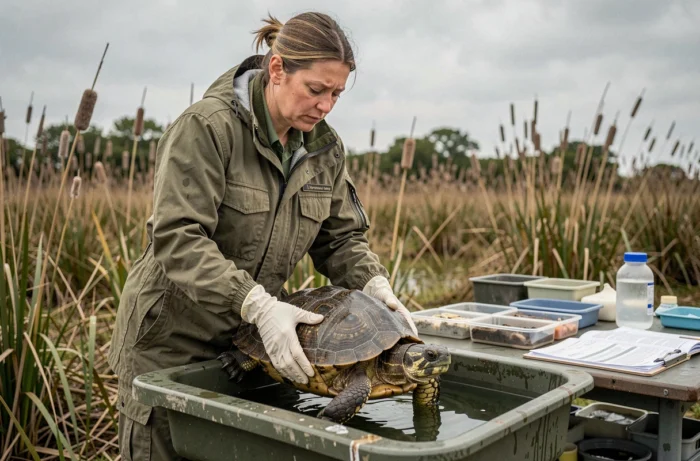
In most vertebrates, the rib cage expands and contracts to ventilate the lungs. Turtles do not have this luxury. Their rigid shell prevents any classical thoracic expansion. They use specific muscle groups located at the base of their limbs to create pumping movements that draw air in and out of the lungs.
This system works well in the open air, but it requires muscular energy. Underwater, in winter, when the muscles are numbed by the cold, active pulmonary ventilation becomes impractical. Cloacal respiration then takes over as the only source of oxygen supply.
This mechanical constraint explains why cloacal respiration evolved in freshwater aquatic turtles and not in other aquatic reptiles. The combination of a shell that blocks classical ventilation and a habitat where access to air can be cut off for months has favored the emergence of this adaptation.
Cloacal respiration and the conservation of freshwater turtles
Understanding this mechanism has direct implications for the protection of species. If a body of water becomes depleted of dissolved oxygen due to pollution, eutrophication, or winter warming, turtles that depend on their cloaca to survive the winter are threatened.
The Mary River turtle is classified as an endangered species. The degradation of water quality in its native river in Australia directly affects its ability to utilize cloacal respiration. Protecting these animals also involves maintaining cold, clean, and well-oxygenated water in their winter habitats.
Cloacal respiration remains one of the most unique mechanisms in the animal kingdom. It reminds us that the respiratory adaptations of freshwater turtles go far beyond lungs, and that the survival of these species depends on specific environmental conditions that human activities can quickly degrade.